
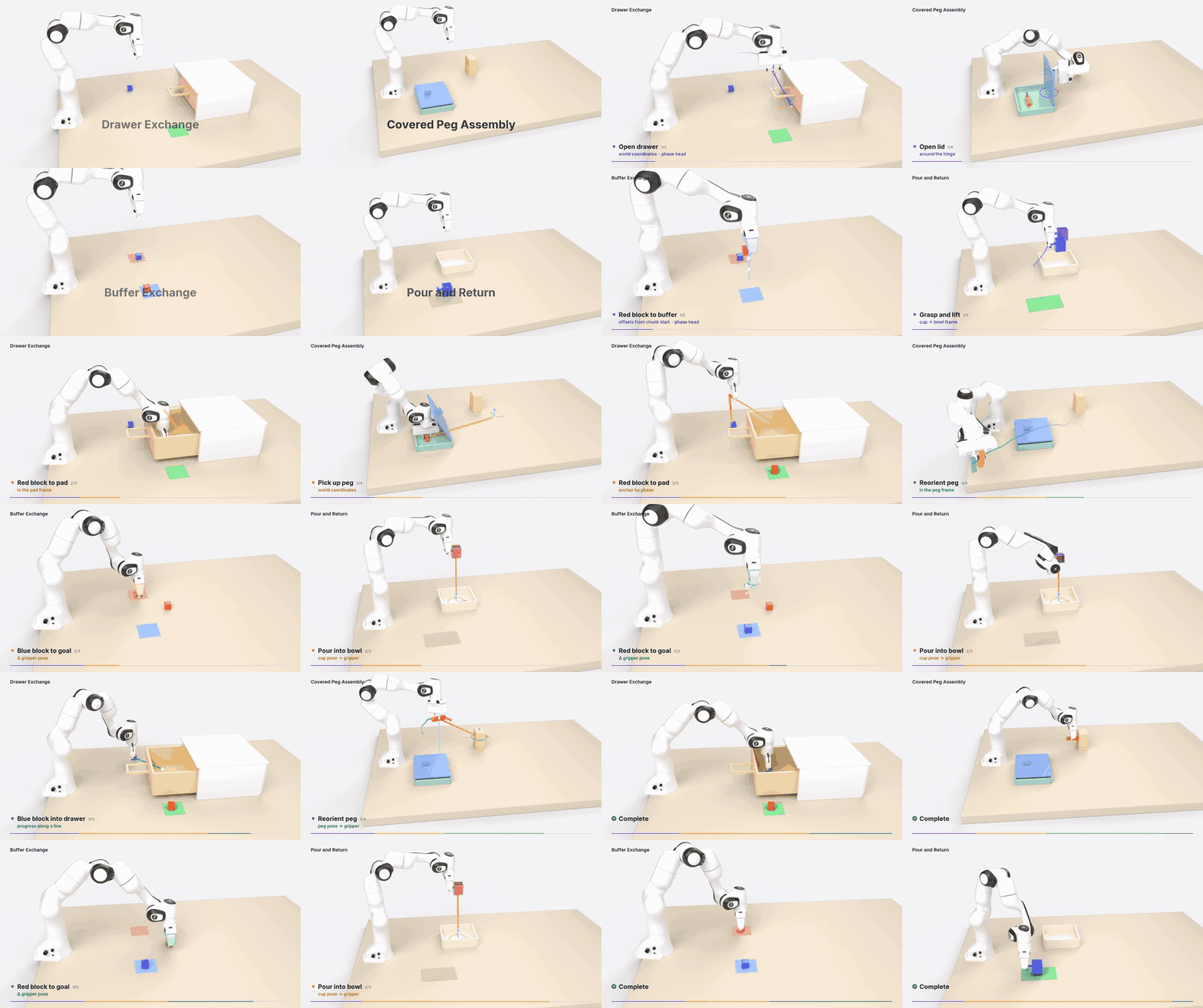
Composed prior-specific policies on four ManiSkill tasks; the label shows the active skill and its prior.
Blender re-renders of logged episodes, sped up 2–4×. Full videos are on the project page.
APPL is an agentic robot learning framework that connects policy learning with agent-based skill selection and composition through structural priors, enabling generalization from a few demonstrations to new scenes and task compositions.
A construction agent segments demonstrations into reusable skills, proposes structural priors, and trains and verifies a policy for each prior. A runtime agent reads interfaces that describe these priors and their applicability to select and compose policies for new task goals. The same structural prior shapes how a policy generalizes during learning and tells the runtime agent when to use it.
Project page · Paper · Hugging Face discussion
This distribution contains the paper's Exp1 and final five-task Exp2, including their baselines and ablations. Agent+VLA and real-robot software are outside this release.
Use Python 3.11 and Pixi 0.80.0 or newer. CI uses 0.80.0; older Pixi versions may not support the checked-in v7 lockfiles. From this checkout:
pixi install --locked
pixi run --locked verify
pixi run --locked tables
pixi run --locked audit
tables recomputes Table 1 from 14,400 individual hidden-test outcomes and frozen
candidate selections, and Table 2 from 560 paired episodes. It writes CSV, JSON,
and Markdown to results/tables/. No model API, GPU, or checkpoint is needed.
The lightweight command can also be run with a Python 3.11 interpreter by setting
PYTHONPATH=src and executing python -m appl_release tables.
| Experiment | Scope | Entry |
|---|---|---|
| Exp1 | Six MetaWorld tasks; 2/5/10/20 demonstrations; B0, B1, q1, q3, q4; 144 trained systems | Exp1 guide |
| Exp2 | Five ManiSkill tasks; DP, SinglePrior, APPL and four ablations; motion/task/composition suites | Exp2 guide |
Exp2 uses the shared posture-constrained Cartesian IK, twelve demonstrations per task, and the policy libraries used in the paper. Its full APPL result is 20/40 motion OOD, 37/40 task-level OOD, and 8/16 composition. DP and SinglePrior have no task-goal input, so they are included only in motion OOD. See scope and protocol for the exact method definitions.
Policy source, contracts, provenance, evaluation cases, and compact results are versioned here. Demonstrations and 222 trained checkpoints are available in two public Hugging Face asset bundles (approximately 38.4 GiB in total). Download and install the matching assets:
pixi run --locked python -m appl_release fetch --bundle exp1
pixi run --locked python -m appl_release fetch --bundle exp2
pixi run --locked python -m appl_release verify --assets
No Hugging Face account or token is required. The manifest pins the v0.1.0
assets to an immutable commit, and the installer checks archive and file
checksums. See asset installation for direct download links,
disk requirements, and installing a local archive with --source.
Exp1 uses the root Pixi environment. Exp2 uses its independent simulator lock:
pixi install --manifest-path environments/exp2/pixi.toml --locked
pixi run --manifest-path environments/exp2/pixi.toml --locked exp2 --help
Training and simulator evaluation target Linux x86_64. Generated-policy workers require Linux isolation support; GPU selection is supplied by the user. The offline result tools use only the Python standard library.
Only new API design sessions and APPL runtime composition need a model API key.
Set your own OPENAI_API_KEY; the default endpoint is the public Responses API.
See API configuration. No key or private provider is distributed.
src/: reusable learning, simulation, isolation, and release tools.experiments/: the two public experiment configurations and protocols.policies/: frozen construction-agent implementations and contracts.assets/: versioned download and checksum manifests.results/: published outcomes and reproducible tables.tests/: offline contract tests and experiment-specific checks.
See architecture, reproduction, validation evidence, contributing, and security.
Code is released under MIT. Third-party components retain their respective notices; see THIRD_PARTY_NOTICES.
If you use this code or the released experiments, please cite the paper (also available from CITATION.cff and GitHub's "Cite this repository"):
@article{jiang2026appl,
  title   = {Agent Priors-guided Policy Learning},
  author  = {Jiang, Puming and Hu, Tianrun and Du, Haozhe and Li, Yibo and
             Xue, Zhiwei and Li, Xinhu and Soh, Harold},
  journal = {arXiv preprint arXiv:2609.35690},
  year    = {2026}
}