
A self-hosted browser for managing unlimited accounts and profiles,
each one a genuinely separate machine: its own fingerprint, GPU, proxy, cookies, and history.
Powered by CloakBrowser, the stealth engine that passes Cloudflare Turnstile, reCAPTCHA v3, FingerprintJS and BrowserScan.
The identities don't just look different. They hold up.
Self-hosted alternative to Multilogin, GoLogin, and AdsPower.
Start free with one concurrent browser, scale to more on a paid plan.



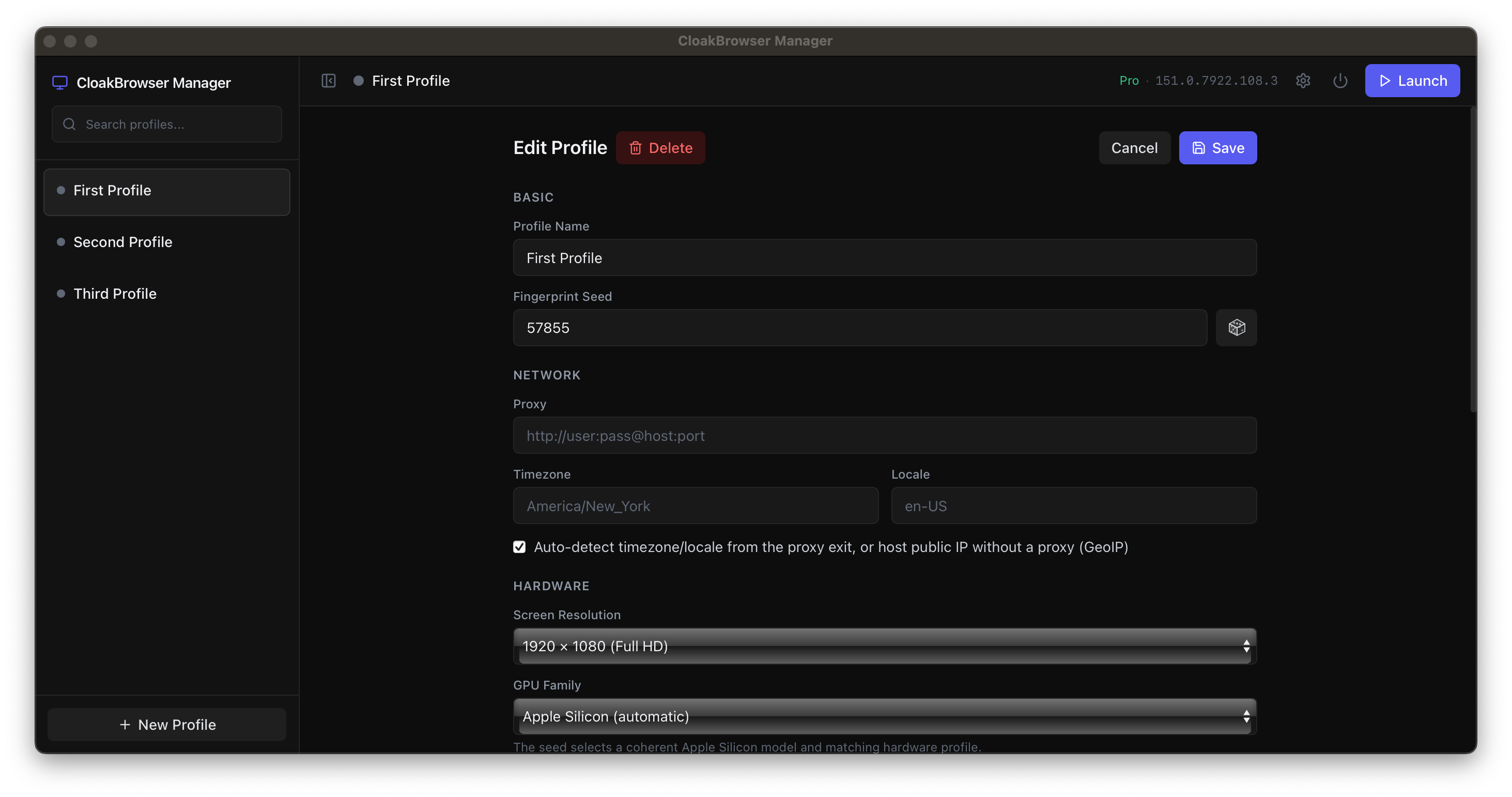
Open a profile and you don't get a new tab, you get a different computer: its own browser fingerprint, GPU, screen, timezone, proxy, cookies, and history. Nothing bleeds between profiles, so your accounts never link back to each other, or to you. Close a profile and reopen it next day, it's the same person, warmed up and ready.
Windows and macOS launch browsers directly in native desktop windows; Linux keeps the Docker/KasmVNC server experience.
Download the installer from the latest release and run it:
- macOS — open the
.dmgand drag CloakBrowser Manager into Applications. (Unsigned during early access — on first launch, runxattr -rc "/Applications/CloakBrowser Manager.app"in Terminal, or approve it under System Settings → Privacy & Security → Open Anyway.) - Windows — run the setup
.exe. (Unsigned during early access — if SmartScreen warns, click More info → Run anyway.)
No Python, Node, or git required. The Manager starts on 127.0.0.1:8080 and opens in your default browser. On first launch it downloads the CloakBrowser engine. Profiles are stored in %LOCALAPPDATA%\CloakBrowser Manager on Windows and ~/Library/Application Support/CloakBrowser Manager on macOS; a logs/manager.log in that folder records what happened if you need it.
Open Settings (gear icon, top right) to add your license key and pick the Stable or Preview channel.
git clone https://github.com/CloakHQ/CloakBrowser-Manager.git
cd CloakBrowser-Manager
./run-macos.sh      # macOS  (or run-windows.bat on Windows)
This path requires Python 3.10+ and Node 18+; the first run creates a local Python environment, installs dependencies, and builds the React UI before starting the Manager.
docker run -p 127.0.0.1:8080:8080 -v cloakprofiles:/data cloakhq/cloakbrowser-managerOr build from source:
git clone https://github.com/CloakHQ/CloakBrowser-Manager.git
cd CloakBrowser-Manager
docker compose up --build
Open http://localhost:8080, create a profile, and click Launch.
Early alpha — this project is under active development. Expect bugs. If you find one, please open an issue and attach the log so we can help. On Windows/macOS it's
logs/manager.login the data folder (%LOCALAPPDATA%\CloakBrowser Manager/~/Library/Application Support/CloakBrowser Manager); on Linux/Docker usedocker logs <container>.
The Manager runs on the CloakBrowser engine, so it needs a key.
Get a free one with GitHub to run one profile at a time on the current build.
Paid plans raise how many profiles run at the same time, from a handful to thousands.
Add your key once and every profile uses it.
Native app (Windows/macOS): open Settings (gear icon, top right), paste your key, choose the Stable or Preview channel, and Save. It applies immediately, no restart. The badge in the top bar shows which tier and binary version are active.
Docker: open Settings (gear icon, top right) the same way, paste your key, and Save. It applies immediately and is stored in the mounted /data volume, so it persists across restarts and image updates. For automated or headless setups, pass it at docker run instead:
docker run -p 127.0.0.1:8080:8080 -v cloakprofiles:/data \
  -e CLOAKBROWSER_LICENSE_KEY=cb_your_key_here \
  -e CLOAKBROWSER_RELEASE_CHANNEL=preview \
  cloakhq/cloakbrowser-manager
Run from source (or docker compose): set it in a manager-root .env:
cp .env.example .env# .env
CLOAKBROWSER_LICENSE_KEY=cb_your_key_here
CLOAKBROWSER_RELEASE_CHANNEL=stable # or: previewThe file is loaded automatically at startup (docker compose reads it too); restart the Manager after changing it. An environment variable overrides the in-app setting.
The popular anti-detect browsers solve the fingerprint, then hand you a new problem: every account you own, every cookie, every session, sits on someone else's servers. And the disguise increasingly doesn't survive real detection, shortcuts in how fingerprints are faked, GPU and WebGL values that don't add up, identities that pass a test page and fail the real site.
CloakBrowser Manager runs on your own machine, and every profile inherits the CloakBrowser engine, so the identities actually hold up.
| Typical cloud anti-detect browser | CloakBrowser Manager | |
|---|---|---|
| Pricing model | Per profile + per seat, forced up-tiering | Flat by concurrency, unlimited profiles |
| Where profiles live | Their cloud | Your machine |
| Fingerprinting | JS-injected into a stock browser | Source-level C++ patched engine |
| The app | Closed box | Open-source GUI (MIT) |
| Native desktop windows | Rare | Windows + macOS |
| Automation API | Add-on / higher tier | CDP built in, every profile |
| Cost of idle accounts | Counts against your limit | Free |
- Unlimited profiles, no per-profile tax — create as many identities as you want. You pay only for how many run at the same time, not how many you keep. Dormant accounts cost nothing.
- Each profile is a different machine — its own fingerprint seed, GPU family, screen, cookies, localStorage, cache, and history, persistent across restarts
- Per-profile network and locale — proxy, GeoIP, timezone, locale, and screen, per profile; timezone and language follow the proxy exit IP automatically
- Platform-aware hardware profiles — automatic Apple Silicon selection and configurable Windows GPU families, coherent within each profile
- Profile organization — create, search, tag, edit, auto-launch, and delete profiles
- Platform-native browsing — Windows and macOS profiles open in normal desktop windows
- Linux server viewing — interact with Docker-launched browsers through KasmVNC in the web GUI
- Playwright/Puppeteer API — connect to any running profile through CDP while watching the same session live
- Humanized interaction — optional human-like mouse, keyboard, and scrolling behavior
- Compatibility controls — unpacked extensions, third-party-cookie support, and advanced Chromium arguments
- Clipboard sync — copy and paste between the Manager and Linux VNC browser profiles
- License and system status — see the active tier, binary version, and Windows font health in the top bar
- Optional authentication — protect the web UI and API with a single token, or run locally without authentication
- Powered by CloakBrowser — the identities don't just look different, they hold up: a source-level C++ patched Chromium engine tested against Cloudflare Turnstile, reCAPTCHA v3, FingerprintJS, and BrowserScan
- Backend: FastAPI (Python)
- Frontend: React + Tailwind CSS
- Browser viewer: native windows on Windows/macOS; noVNC/KasmVNC on Linux Docker
- Database: SQLite
- Browser engine: CloakBrowser (stealth Chromium binary)
python -m venv .venv && source .venv/bin/activate
pip install -r backend/requirements.txt
uvicorn backend.main:app --reload --host 127.0.0.1 --port 8080cd frontend
npm install
npm run devdocker compose up --build- Windows or macOS native: Python 3.10+, Node.js 18+
- Linux server: Docker 20.10+
- ~2 GB disk (application + browser binary)
- ~512 MB RAM per running profile
Pull the latest source and run the platform launcher again. It installs changed dependencies and rebuilds the interface automatically.
git pullWindows: run-windows.bat
macOS: ./run-macos.sh
Pull the latest image and recreate the container:
docker pull cloakhq/cloakbrowser-manager
docker stop <container-id>
docker rm <container-id>
docker run -p 127.0.0.1:8080:8080 -v cloakprofiles:/data cloakhq/cloakbrowser-manager
Profiles and session data remain in the native application-data directory or the cloakprofiles Docker volume across updates.
Every running profile exposes a CDP (Chrome DevTools Protocol) endpoint. Connect Playwright or Puppeteer to automate a profile while watching it live in the browser.
from playwright.async_api import async_playwright

async with async_playwright() as pw:
    browser = await pw.chromium.connect_over_cdp(
        "http://localhost:8080/api/profiles/<profile-id>/cdp"
    )
    page = browser.contexts[0].pages[0]
    await page.goto("https://example.com")
const { chromium } = require("playwright");
const browser = await chromium.connectOverCDP(
"http://localhost:8080/api/profiles/<profile-id>/cdp"
);
const page = browser.contexts()[0].pages()[0];
await page.goto("https://example.com");The CDP URL is available from the running-profile view. The same browser session is accessible through its native window on Windows/macOS or through VNC on Linux Docker, and programmatically through the API on every platform.
The container binds to localhost only. To access from a remote server:
ssh -L 8080:localhost:8080 your-serverThen open http://localhost:8080.
By default, there is no authentication (ideal for local use). To protect the web UI and API when hosting on a network, set the AUTH_TOKEN environment variable:
docker run -p 127.0.0.1:8080:8080 -v cloakprofiles:/data -e AUTH_TOKEN=your-secret-token cloakhq/cloakbrowser-managerOr in docker-compose.yml:
environment:
  - AUTH_TOKEN=your-secret-token
When AUTH_TOKEN is set:
- The web UI shows a login page. Enter the token to unlock.
- API consumers pass the token via
Authorization: Bearer <token>header. - VNC WebSocket connections are authenticated via the login cookie.
- The
/api/healthendpoint remains unauthenticated (for Docker healthcheck); it exposes no system details. The/api/statusendpoint (running counts, version) now requires authentication.
Note: The auth token is transmitted in cleartext over HTTP. If you expose the Manager to the internet, put it behind a reverse proxy with HTTPS (Caddy, nginx, Traefik).
- This application (GUI source code) — MIT. See LICENSE.
- CloakBrowser binary (compiled Chromium) — governed by version-specific subscription terms and may not be redistributed. See BINARY-LICENSE.md.
The GUI application requires the CloakBrowser Chromium binary to function. The binary is automatically downloaded on first launch and is governed by its own license terms. If you fork or redistribute this application, your users must comply with the CloakBrowser Binary License.
Contributions are welcome. Please open an issue first to discuss what you'd like to change.
- lhq1363511234-arch — native Windows support foundation
- quorentindupres-dev — native macOS workflow and Manager integration concepts
- shellus — auth-gated status endpoint and unauthenticated health probe
- hayka-pacha — profile reset endpoint
- CloakBrowser — github.com/CloakHQ/CloakBrowser
- Website — cloakbrowser.dev
- Bug reports — GitHub Issues
- Contact — cloakhq@pm.me