(Full name: Aino Aiko アイノ・アイコ aka 愛のAI子 aka 相野愛子)
A local-first AI companion with a browser WebUI + VRM avatar, optional simple CLI, persistent memory, web search, microphone input, and MioTTS voice output. Optimised for constrained hardware — runs on a Jetson Orin Nano with 8GB unified RAM.
Author: OppaAI · Beautiful British Columbia, Canada







Phase 2 voice is implemented, and Phase 2.5 agentic workflows are now active. The default launch path is the browser WebUI/VRM frontend, including a WebSocket bridge for chat, vitals, voice status, expression, viseme, and browser microphone events. --cli remains available for simple local testing.
ASR and TTS run through the local machine by default. WebUI microphone streaming exists in the frontend/backend bridge, but full remote voice-device polish is still experimental.
Known Issues:
- TTS via MioTTS sometimes cannot inference proper voice output due to memory constraint (MioTTS and embedding models are still tuned for Jetson memory pressure; Harrier replaced BGE for better semantic separation at 640d)
- Time latency between ASR voice input ends to beginning of TTS voice output are still over 5 sec for normal chats. Need to figure out how to do proper synchronized text and speech streaming to save a couple seconds.
- ASR may have transcribing errors that output wrong text or even wrong language, especially when accent is present in speaker's voice or when using low quality microphone.
- Barge-in haven't been fully tested and may cause some runtime issues that needed to conduct more testing and debugging.
Click the following image to watch on YouTube ▶
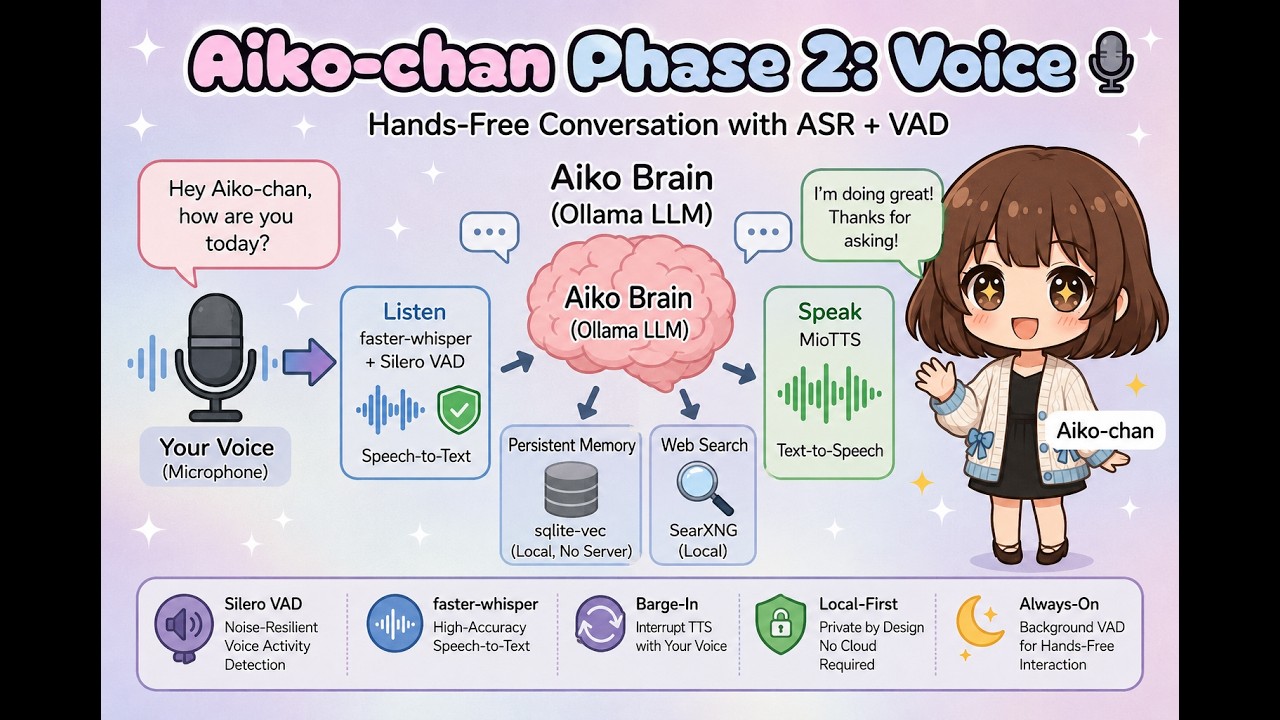
This project currently serves as:
- a local AI companion chatbot with persistent memory, web search, TTS, ASR, a terminal UI, and an optional browser WebUI/VRM avatar;
- a stress test for running a full conversational stack on constrained hardware such as an 8 GB VRAM GPU or Jetson Orin Nano;
- a precursor and testing sandbox for the larger Grace / AuRoRA project;
- an experimental playground for memory decay, nightly consolidation, daily reflection publishing, agentic tools, scheduled reminders, and workflow skills.
- Local-first LLM — OpenAI-compatible endpoint (llama.cpp
llama-serverrecommended), runs entirely on your hardware - Curses TUI — Full-screen cyberpunk terminal interface with streaming tokens, status panels, and command palette
- Browser WebUI (optional) — Modern web interface with VRM avatar, WebSocket bridge, browser microphone streaming
- Persona system — Rich personality defined in
persona/SOUL.mdwith identity, skills, and user profile
- sqlite-vec + custom Harrier ONNX embedder — Serverless vector store, no Qdrant/mem0 required
- Hybrid retrieval — KNN vector + FTS5 lexical + Reciprocal Rank Fusion
- Ebbinghaus-style decay — Memories fade naturally unless pinned
- Pinned memories —
/remembercommand makes memories decay-proof - Nightly dream consolidation — Midnight
dream()merges near-duplicates, prunes decayed memories, pins daily summaries - Monthly consolidation — Older full months summarized into durable pinned memories
- Encrypted storage option — SQLCipher via
AIKO_SQLITE_ENCRYPTION=1for per-user encrypted databases
- Local SearXNG — Private web search instance via Docker
/web <query>command — Grounded answers with source citations- Deep research tool — Multi-step search, fetch, and synthesis for agentic tasks
- ASR — SenseVoice via sherpa-onnx (int8 ONNX, multilingual JP/EN)
- VAD — Dual energy VAD and Silero VAD for voice activity detection
- Microphone — PulseAudio
pareccapture (local) + browser WebAudio Worklet (WebUI) - Barge-in — Speak over Aiko mid-response to interrupt
- Speaker verification — Optional ERes2Net via sherpa-onnx speaker embeddings for owner-only voice activation
- TTS — MioTTS via llama.cpp + synthesizer server (0.4B Q4KM), bilingual JP/EN, karaoke-style text sanitization
- Staged warmup — ASR, VAD, TTS, and microphone warmed during boot
- ReAct task loop — LLM plans, calls tools, observes, repeats until done
- Toolkit modules — Web search, fetch, planning, scheduling, workspace notes, photo ingestion, repo inspection
- Skill registry — Markdown workflow definitions in
agentic/skillsets/*.md - Skill context injection — Relevant skill instructions automatically retrieved in agentic mode
- Dual-path routing — Fast semantic exemplar routing (default) + optional LLM router fallback
- Final-answer verification — Self-critique and repair loop for tool outputs
- Scheduling & reminders — Per-user
schedule.jsonwith cron-like recurrence, due announcements - Workspace tools — Safe note-taking, file reads, photo scanning under
WORKSPACE_ROOT
- Midnight scheduler — Runs automatically at configurable hour
- Salient memory boost — Important memories reinforced
- Near-duplicate merging — Vector similarity deduplication
- Decay pruning — Low-score memories removed
- Daily reflection — Optional Hugo + GitHub Pages blog publishing
- Cross-session coherence — Ongoing improvements to memory continuity
- OAuth identity — Provider-scoped user IDs (
github_123,patreon_456) - Per-user isolation —
~/.aiko/<user_id>/{memory.db, schedule.json, workspace/, user} - SQLCipher encryption — Per-user encrypted databases with server-secret derived keys
- Workspace isolation — Per-user workspaces, future Google Drive mount support
- three.js + @pixiv/three-vrm — Browser-rendered VRM avatar
- WebSocket bridge — Real-time chat, vitals, voice state, expressions, visemes
- Browser microphone — AudioWorklet PCM capture → dual energy VAD + Silero VAD → backend ASR
- Expression system — Idle, happy, annoyed, flustered, thinking (planned)
- Lip-sync — Viseme-driven from TTS audio (planned)
| Document | Description |
|---|---|
| docs/INSTALL.md | Step-by-step installation for every component |
| docs/HISTORY.md | How Aiko evolved from a chatbot into a companion |
| docs/ROADMAP.md | Detailed phase-by-phase feature roadmap |
| docs/TESTS.md | Manual smoke-test checklist for each phase |
| docs/MULTI_USER.md | Multi-user isolation, encryption, and deployment notes |
| docs/ARCHITECTURE.md | Runtime architecture, module boundaries, and data flows |
flowchart TD
    YOU[You] --> UI[UI\nWebUI or CLI]
    UI --> THINK[Think\nllama.cpp/OpenAI-compatible LLM]
    THINK <-->|async| MEM[Memory\nsqlite-vec + Harrier llama.cpp server]
    THINK <-->|on demand| SEARCH[Web search\nSearXNG]
    THINK --> SPEAK[Speak\nMioTTS]
    LISTEN["Listen\nSenseVoice (sherpa-onnx) + dual energy VAD + Silero VAD"] --> THINK
    THINK -.->|nightly| DREAM[Dream\nconsolidation]
    DREAM -.->|optional| REFLECT[Reflect\nHugo + GitHub]
| Layer | Implementation |
|---|---|
| Entry point | main.py (browser WebUI default, --cli optional simple CLI) |
| Interface | browser WebUI in interface/webui/ by default; simple local CLI via --cli |
| Chat model | llama.cpp or any OpenAI-compatible local server via openai.OpenAI |
| Long-term memory | custom sqlite-vec backend (no server required) |
| Embeddings | Harrier llama.cpp, harrier-oss-v1-270m via llama.cpp server |
| Memory lifecycle | Ebbinghaus-style decay, pinned memories, nightly dream() consolidation |
| Web search | local SearXNG instance through agentic/toolkit/research.py |
| TTS | MioTTS 0.4B via llama.cpp server, external MioCodec synthesizer server |
| ASR | SenseVoice via sherpa-onnx with Silero VAD and ERes2Net Speaker verification |
| Reflection publishing | optional GitHub REST API + Hugo markdown |
| Agentic task mode | agentic/agentic.py ReAct loop + agentic/toolkit/tools.py facade + agentic/toolkit/ modules |
| Skills | agentic/skillsets/*.md workflow registry loaded by agentic/skills.py |
| Scheduling | local schedule/reminder runner using ~/.aiko/<user_id>/schedule.json |
| Multi-user | OAuth provider-scoped IDs, per-user ~/.aiko/<user_id>/ isolation |
| Encryption | optional SQLCipher via AIKO_SQLITE_ENCRYPTION=1 |
Prerequisites: Python 3.12, uv, CUDA 12.6, Docker + Compose, a llama.cpp/OpenAI-compatible local LLM server, and a pulled/served chat model (3B+ recommended).
Full installation walkthrough → docs/INSTALL.md
git clone https://github.com/OppaAI/Aiko-chan.git
cd Aiko-chan
cp .env.example .env        # fill secrets only; edit config/*.yaml for settings
docker compose up -d
uv sync
uv run python main.py            # browser WebUI, full voice if services are available
uv run python main.py --text # WebUI keyboard input, ASR/TTS toggled off but loaded
uv run python main.py --cli # simple authenticated local CLI
uv run python main.py --debug # show memory hits each turn
uv run python main.py --clear-mem # wipe all memories and exit| Command | Action |
|---|---|
/quit or /exit |
End the session |
/reset |
Clear short-term context; long-term memory persists |
/memory |
Print all stored memories |
/clear |
Wipe all long-term memories |
/remember |
Pin the last exchange — decay-proof |
/think <question> |
Higher-token reasoning turn; suppresses 🤔 scratchpad |
/web <query> |
SearXNG search → grounded answer |
/voice |
Toggle TTS on/off |
/listen |
Toggle ASR on/off |
/proactive |
Toggle proactive idle check-ins on/off; timing, quiet/focus windows, and prompt hints configured in config/proactive.yaml |
/help |
Show the command list |
Aiko-chan/
├── main.py                 # entry point; WebUI default, --cli for simple local testing
├── config/                 # category YAML settings; secrets stay in .env
├── cognition/
│   ├── think.py            # chat facade, routing, history, scheduled-job callbacks
│   └── reason.py           # shared embedding/ranking helpers
├── memory/
│   ├── memorize.py         # sqlite-vec memory, recall, pinned memories
│   ├── vecstore.py         # SQLite/sqlite-vec helpers
│   ├── forget.py           # decay scoring and cleanup gates
│   ├── consolidate.py      # periodic memory consolidation
│   ├── journal.py          # encrypted journal blob store
│   └── reflect.py          # Hugo/GitHub reflection publisher
├── sensory/
│   ├── speak.py            # MioTTS HTTP client
│   └── listen.py           # SenseVoice (sherpa-onnx) + Silero VAD
├── agentic/
│   ├── agentic.py          # ReAct task loop, tool schemas, tool dispatch
│   ├── schema.py           # graph-first playbook DAG executor
│   ├── capability.py       # capability matching for task-mode tool filtering
│   ├── experience.py       # procedural task-run experience store
│   ├── skills.py           # skill registry and workflow retrieval
│   ├── tools.py            # stable facade for pure callable tools
│   ├── wiki.py             # wiki-card retrieval for task mode
│   ├── skillsets/          # human-readable workflow documents
│   └── toolkit/            # focused tool implementations: research, planning, schedule, photo, repo, jobs
├── system/                 # config, wakeup, schedule runner, logging, userspace
├── interface/
│   ├── webui/              # browser WebUI backend + static frontend/VRM bridge
│   └── cli/                # auth and simple CLI helpers
├── persona/                # soul/personality and prompt policy files
├── wiki/                   # trusted local knowledge cards
├── docs/                   # install, architecture, roadmap, tests, history
├── assets/                 # images and VRM assets
├── docker-compose.yml
├── pyproject.toml
├── uv.lock
├── .env.example
└── README.md
| Phase | Name | Status |
|---|---|---|
| 1 | Soul — CLI, Ollama, mem0 + Qdrant, SearXNG | ✅ Done |
| 1.5 | Stream — streaming pipeline, persona, first UI, test TTS models | ✅ Done |
| 2 | Voice — SenseVoice ASR, Silero VAD, MioTTS, hands-free talk | ✅ Done |
| 2.1 | Social — X, Threads, IG, Discord, social media | 🔲 Planned |
| 2.2 | Message — Email, Telegram, Discord, Slack, messaging services | 🔲 Planned |
| 2.5 | Agent — tool registry, skill workflows, scheduled local tasks | ⏳ Active |
| 3 | Face — VRM avatar, three-vrm, expressions, lip-sync | 🔲 Planned |
| 4 | Presence — emotional state, mood, relationship progression | 🔲 Planned |
| 5 | Mobile — React Native / Flutter, WAN, push notifications | 🔲 Planned |
| 6 | Multimodal — camera, vision input, webcam expression awareness | 🔲 Planned |
| 7 | Autonomy — scheduled operation, self-directed exploration | 🔲 Planned |
Full details → docs/ROADMAP.md
All non-secret runtime settings live in config/*.yaml. Environment variables in .env override YAML at runtime.
| Config file | Purpose |
|---|---|
config/index.yaml |
Ordered list of YAML files loaded at startup |
config/system.yaml |
Identity, logging, userspace, schedule, reflection/social settings |
config/cognition.yaml |
LLM endpoints, routing, token limits, vector-cache settings |
config/memory.yaml |
Memory, embedding, decay, experience, consolidation settings |
config/skills.yaml |
Agentic routing thresholds, tool configs, graph executor settings |
config/sensory.yaml |
MioTTS, ASR, VAD, speaker verification, and barge-in settings |
config/interface.yaml |
WebUI ports, avatar path, streaming behavior |
| Phase | Before | After |
|---|---|---|
| 1 → 1.5 | CLI + Ollama + mem0/Qdrant | Browser WebUI + llama.cpp + streaming |
| 1.5 → 2 | Text-only | Voice loop: SenseVoice + Silero VAD + MioTTS |
| 2 | mem0 + Qdrant (server, OOM on Jetson) | sqlite-vec + custom Harrier ONNX (serverless, local) |
| 2 | fastembed (BGE v1.5) | Harrier OSS v1 270M Q8 GGUF embedder (640d, last-token pooling) |
| 2 → 2.5 | Chat only | Agentic ReAct loop + skills + scheduling + toolkit |
| 2.5 | Keyword-only routing | Dual-path: semantic exemplar + optional LLM router |
Key architectural decisions:
- No external memory server — sqlite-vec runs in-process, zero Docker deps for memory
- Harrier over BGE — Newer 640-dim decoder-only embedder with query instructions, better semantic separation
- Custom ONNX embedder — Harrier needs last-token pooling; fastembed only exposed MEAN/CLS
- Tools ≠ Skills — Tools are executable Python functions; skills are human-readable Markdown workflows
- Single agentic loop — Semantic routing + optional LLM routing + ReAct + skills = one coherent task layer
- Memory uses a custom sqlite-vec backend — no Qdrant server or mem0 required. Qdrant + mem0 were dropped in Phase 2 due to OOM issues on the Jetson Orin Nano.
- Entry point is
main.py, notcli.pyanymore. - LLM runtime is now an OpenAI-compatible endpoint (
LLM_BASE_URL/LLM_MODEL), usually llama.cppllama-server; older Ollama-specific settings are archived/outdated. - TTS runtime is MioTTS server with 0.4B Q4KM model (Tried XTTS with CoquiTTS, Kokoro and RealtimeTTS, PocketTTS but removed due to Jetson OOM/latency/quality tradeoffs).
- ASR runtime is SenseVoice via sherpa-onnx + dual energy VAD + Silero VAD. (Tried ReazonSpeech K2 and faster-whisper but removed due to English capability and RAM usage tradeoffs respectively)
- Reflection publishing fails safely if
GITHUB_TOKENorGITHUB_REPOare missing. - Multi-user isolation uses per-user directories under
~/.aiko/<user_id>/with optional SQLCipher encryption. - WebUI VRM frontend is experimental; remote voice device polish is ongoing.
If you find this project useful, consider buying me a coffee ☕

- Two-way messenger adapters are native background services for WebUI/CLI sessions via
AIKO_MESSENGER_ADAPTERS; only Telegram, Discord, Matrix, and Slack are supported for conversational ingress/egress. - Lane A1 syndicates the weekly Patreon Aiko development post on Saturdays at 18:00: full reposts go to the Hugo-backed GitHub Pages dev blog; short teasers go to X, Bluesky, Mastodon, Discord
#aiko_dev, and Threads when image hosting is available. YouTube remains video-upload only, not YouTube Community teaser posting. Lane A2 manual posting remains out of Aiko. - Lane B is the curated photo pipeline for Pixelfed posting through the social MCP server.
- Lane C YouTube video posting continues to use the existing MCP posting pipeline.
- Lane D creates one Threads teaser-list draft per night at 23:00 for tech jobs available today, using only the configured CivicJobs.ca Lower Mainland RSS and Job Bank Canada filtered RSS feeds, filtered by TECH_JOB_KEYWORDS.
- Bluesky, Mastodon, and YouTube are one-way posting tools only, not two-way adapters.
- Nightly reflection remains native GitHub/Hugo publishing rather than MCP.