This model implementation originally began as a final project for the UCLA graduate course A&O SCI 212A - Numerical Methods for Geophysical Fluid Dynamics.
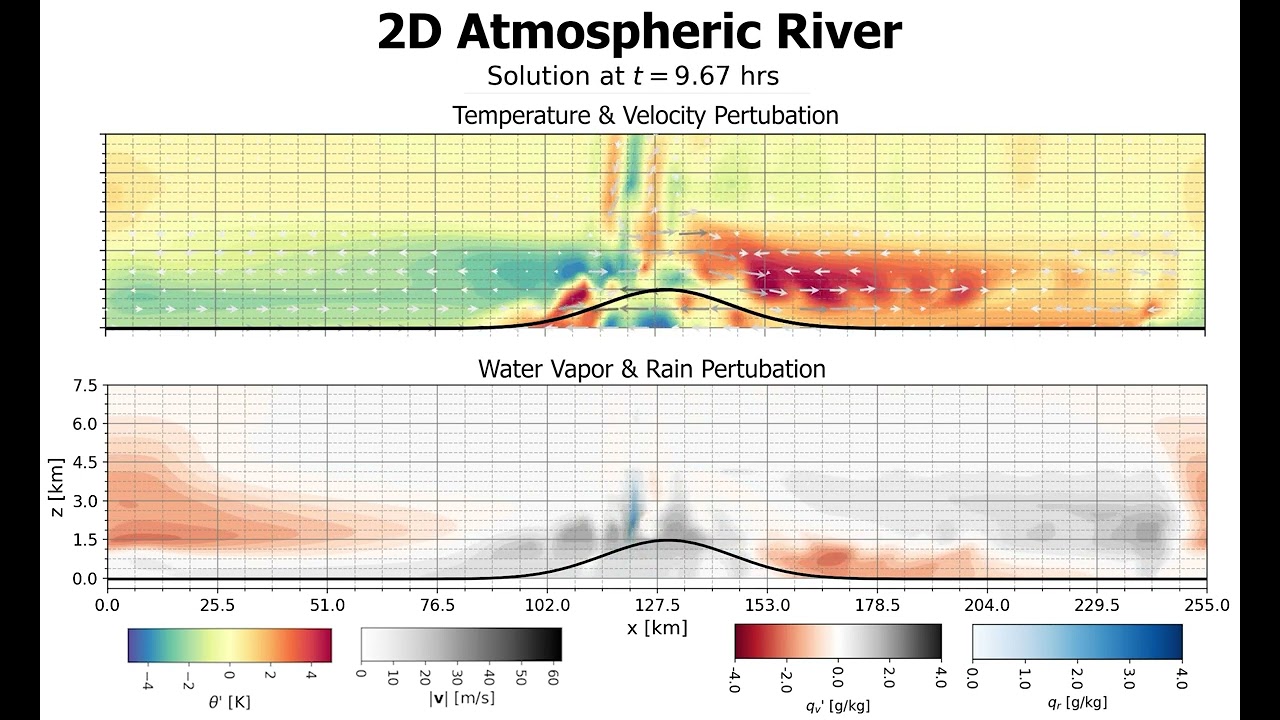
The repository contains a 2D minimal numerical model for simulating moist, precipitating turbulent convection by using the Boussinesq approximation and the Fast Autoconversion Rain Evaporation (FARE) formulation. The Boussinesq approximation assumes incompressibility, with density variations limited to the moist buoyancy term. In the FARE limit, water vapor above saturation is assumed to instantly condense into rainwater, and rainwater quickly evaporates back into water vapor as it falls. Most parameters, schemes, and scenarios are as described in:
Hernandez-Duenas, Gerardo, Andrew J. Majda, Leslie M. Smith, and Samuel N. Stechmann. “Minimal Models for Precipitating Turbulent Convection.” Journal of Fluid Mechanics 717 (February 2013): 576–611. https://doi.org/10.1017/jfm.2012.597.
The FARE model can appropriately simulate nonlinear advection and phase changes associated with moist atmospheric systems, directly iterating velocities (u, w), pressure (P), and scalar pertubations such as rainy potential temperature (docs/FORMULATION.md.
Three key scenarios are presented as examples in the package, which are elaborated on in docs/SCENARIOS.md:
- Scattered Convection: Baseline turbulent simulation with horizontally uniform moisture/cooling forcing, no terrain modifications, and initial near-surface temperature pertubation as described in Hernandez-Duenas et al 2013.
- Squall Line: Introduces background wind shear to organize convection into fronts as specified in Hernandez-Duenas et al 2013.
- Atmospheric River: Introduces a horizontally non-uniform moisture forcing, a Rayleigh-damped sponge mountain, and sponge layers in the upper and side boundaries to dampen gravity waves.
The model can be adapted to 3D with not too much difficulty as both horizontal directions are assumed to be fully periodic, meaning that the FFTs can simply be replaced with 2D FFTs.
For an example implementation of this package for FARE simulations, see notebooks/demo.ipynb.
The object-oriented package and code lives in fare_model/. Install it from the repository root with:
pip install -e .The preset scenarios tables from profiles/moistening_profile.xls and profiles/cooling_profile.xls.
You can then create, configure, and run a preset or custom simulation by instantiating a FARE class object:
from fare_model import FARE, atmospheric_river

model = (
    FARE()
    .set_grid(L=(256000, 12000), grid=(257, 200), dt=1.1, T=80000, s=40)
    .set_comp(explicit_scheme="AB3")
    .set_scenario(atmospheric_river())
    .set_state()
)
model.solve(save=True, output_dir="output/atmospheric_river")
Fourier-space states used in the active simulation are available through model.state; saved physical-space solutions and diagnostics are available through model.sol and model.stats. save=True writes solution.npz, stats.npz, state.npz, and metadata.json to the supplied output directory.
You can also continue an existing simulation without resetting it using:
model.continue_solve(additional_steps=1000, save=True, output_dir="output/atmospheric_river")The package includes preset shallow_convection(), squall_line(), and atmospheric_river() scenarios, which can be applied onto the FARE object like so:
from fare_model import shallow_convection
model.set_scenario(shallow_convection())
Lastly, the package can also be accessed and ran through the command line; see fare_model\__main__.py for details.