





A multi-agent RAG system for role-based access-controlled financial document Q&A. Achieves 72.7% correctness pass rate on the public FinanceBench benchmark using selective agentic retrieval, a BGE cross-encoder reranker, and a self-hosted LLM observability stack.
Evaluated on the FinanceBench benchmark (150 questions across 32 companies):
| Metric | Value |
|---|---|
| Correctness pass rate | 72.7% (109/150) |
| Refusal rate | 6.7% (10/150) |
| RAGAS faithfulness | 0.747 |
| DeepEval faithfulness | 0.844 |
| DeepEval contextual recall | 0.768 |
Per-slice pass rate: lookup 68.6% (n=86), multi-hop 84.6% (n=13), calc 76.5% (n=51).
The correctness judge is a Claude Sonnet 4.6 + structured-prompt setup calibrated to Cohen's κ = 0.932 against an 89-question hand-labeled set with an adversarial leniency guard. Full methodology, per-judge scores, and reproduction commands in docs/evaluation.md.
| System | Approach | Accuracy |
|---|---|---|
| Mafin 2.5 / PageIndex | Vectorless reasoning over hierarchical document tree | 98.7% |
| DANA | Domain-aware neurosymbolic agent with deterministic operators | 94.3% |
| GPT-4-Turbo · long context (128k) | Whole-document prompting | ~79% |
| Claude-2 · long context (100k) | Whole-document prompting | ~76% |
| This project | Multi-agent RAG with selective research-agent subgraph + RBAC + HITL | 72.7% |
| FinanceBench paper baselines | Vector retrieval + GPT-4 / Llama-2 | 38–43% |
| GPT-4-Turbo · top-k vector RAG | Standard retrieval, no agent | ~19% |
Long-context approaches score higher but are not enterprise-deployable — 10-K filings frequently exceed 128k tokens, and whole-document prompting is impractical at scale due to latency and cost. The 72.7% here is measured on a production-shaped pipeline (fixed institutional corpus, batched retrieval, RBAC at the storage layer, HITL on high-stakes outputs).
An analyst is refused a confidential invoice; a c-level re-login unlocks the same query — access enforced at the retrieval layer.

Finance is blocked at the $100K gate; an admin approves in a second terminal and the answer is released back — multi-party, across sessions.

Follow-up questions resolve against thread history — "And Microsoft?" is rewritten using the prior turn.

pip install financebench-rag-agent
financebench setup                    # brings up the 4-service docker stack, seeds 8 sample PDFs
financebench login -u analyst         # password analyst123
financebench chat
The full 360-PDF FinanceBench corpus is published as a pre-vectorized snapshot on the Hugging Face Hub — voyage-finance-2 embeddings plus chunked text and a manifest — so anyone can seed the entire benchmark in minutes and skip ~$5-15 of embedding cost and ~30 min of ingest:
financebench seed --from-hf cmpunkmannu/financebench-voyage-finance-2-embeddings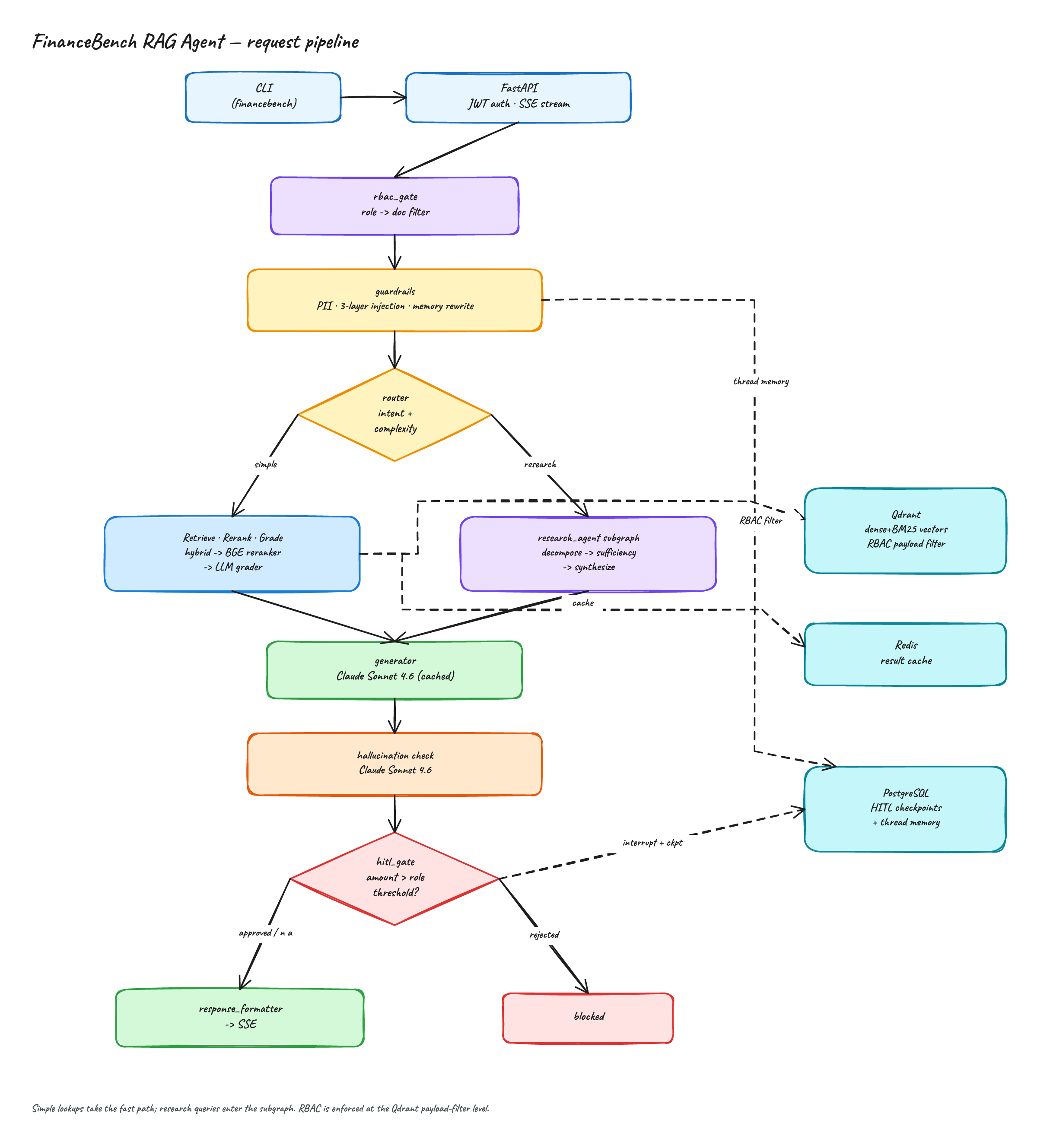
A router classifies each query as a simple lookup or research-required. Simple lookups take the fast direct path (retrieval → BGE reranker → grader → Claude generator); research queries enter a multi-turn subgraph that decomposes the question, retrieves per sub-question, grades sufficiency, and synthesizes a final answer. RBAC is enforced at the Qdrant payload-filter level — agentic queries cannot bypass access control. High-stakes answers (above a per-role dollar threshold) pause via LangGraph's interrupt() for multi-party human approval, with state checkpointed to Postgres so the workflow survives container restarts.
- Backend — FastAPI · LangGraph · Qdrant · PostgreSQL · Redis · PyJWT
- Client —
financebenchCLI: typer · rich · prompt_toolkit · httpx-sse · token-streaming over SSE - LLMs — Claude Sonnet 4.6 · gpt-4o-mini · Llama 3.3 (via Groq, optional)
- Retrieval — OpenAI text-embedding-3-small or voyage-finance-2 · BGE-reranker-v2-m3 cross-encoder
- Observability — self-hosted LiteLLM proxy + Langfuse v3 + Redis semantic cache (full stack only)
- Safety — Microsoft Presidio PII detection · LLM Guard · LLM classifier (3-layer cascade)
- Evaluation — RAGAS · DeepEval · custom LLM correctness judge
- Not deployed to production — runs locally via
docker compose up -d. No public URL or live traffic. - CLI is the canonical client today. A Next.js web frontend is in progress in
web/but not wired into the deployment story. - Below the top-published systems (Mafin 2.5 at 98.7%, DANA at 94.3%) — see comparison table above for context.
git clone https://github.com/Rishabhmannu/financebench-rag-agent.git
cd financebench-rag-agent
pip install -e ".[backend,dev]" && cp .env.example .env   # backend extras + dev tools
financebench setup                                         # docker compose + seed corpus
For self-hosting the full 11-service stack (LiteLLM + Langfuse), upgrade flows, and production hardening, see docs/deploy.md and docs/upgrade.md.
- docs/cli.md — CLI reference, slash commands, multi-party HITL workflow
- docs/deploy.md — Self-host: stack profiles, env vars, backup, hardening
- docs/upgrade.md — Upgrade cookbook by change type
- docs/evaluation.md — Methodology, results, reproduction
- docs/engineering-log.md — Engineering decisions and tradeoffs
- docs/setup.md — Test accounts, environment, dev commands
- docs/architecture.md · docs/api-reference.md · docs/rbac-matrix.md · web/README.md
MIT