
All glory and honor to God יהוה in the name of Yeshua the Messiah (Jesus Christ).

Intelligent, Security-Conscious, and Designed for Effortless Productivity — Because With Rullst, We Rule!
An open-source, Axum-based framework suite.
Build beyond the endpoint—with code you can inspect and boundaries you control.





Start building · Try live examples · Documentation · Contribute
v12.0.0 is published. Install the stable package below.
mainreceives v12 maintenance; next-major work lives onv13. The legacyv5line is no longer maintained. Release record · Compatibility policy.
Generate a project, choose a blueprint and database, then start the development loop:
cargo install cargo-rullst --version 12.0.0 --locked
cargo rullst new my_app
cd my_app
cargo rullst dev
Choose Blank / API, Blog, SaaS, LMS, Portfolio or ERP. Generated projects contain ordinary Rust you can inspect and change.
Installation and prerequisites · Zero-to-Hero tutorial · Build a JSON REST API · CLI reference
Explore applications hosted on Azure Container Apps, with their code and deployment recipes in Rullst/examples:
| Application | Explore |
|---|---|
| 🌐 Showcase — blog, SSR and selected integration demonstrations | Open Showcase ↗ |
| 🎓 LMS — course catalog and learning-platform example | Open LMS ↗ |
| 💼 Portfolio — projects, skills and experience presentation | Open Portfolio ↗ |
These are independently maintained demo snapshots and may lag the stable release. Showcase payment fixtures are not live checkout. Deployment availability, native downloads and provider approval are separate from framework test evidence; use test data, not sensitive information, in public demos.
Rullst coordinates application foundations in one versioned Rust workspace:
- Product-shaped starting points: six blueprints, inspectable generators, supervised rebuild/restart, a terminal dashboard and assisted upgrades.
- Data and background work: Active Record, transactions and an outbox for supported relational databases, plus explicitly scoped specialized stores and durable local messaging.
- Identity and security: sessions, Argon2id, passkey and OAuth2/OIDC helpers, ownership checks, CSRF, secure headers and bounded request defenses.
- AI and service integrations: local/cloud AI clients, tenant-aware RAG, transactional email and provider-specific payment/webhook adapters.
- Developer visibility: Studio for local runtime telemetry and Nexus for explicitly authorized registered-model administration.
- A web-first foundation: SSR with HTMX, JSON APIs and generated Omni/Tauri shells. Native toolchains, signing and device validation remain separate steps.
Explicit boundaries are part of the design. Database capabilities are not interchangeable; security middleware does not replace application authorization; live fiscal authorization and remote message-broker adapters remain roadmap work. Choose the features you need and review their documented capabilities.
Rullst builds on Axum, Tokio, Tower and SQLx, with standard routers and pools available at documented integration points. You can adopt it incrementally. Why Rullst? · Axum & SQLx escape hatches · Omni's web-first contract
See the CLI and blueprint gallery
Recorded repository previews, not live release evidence. The current CLI can differ in menu options, labels and layout.
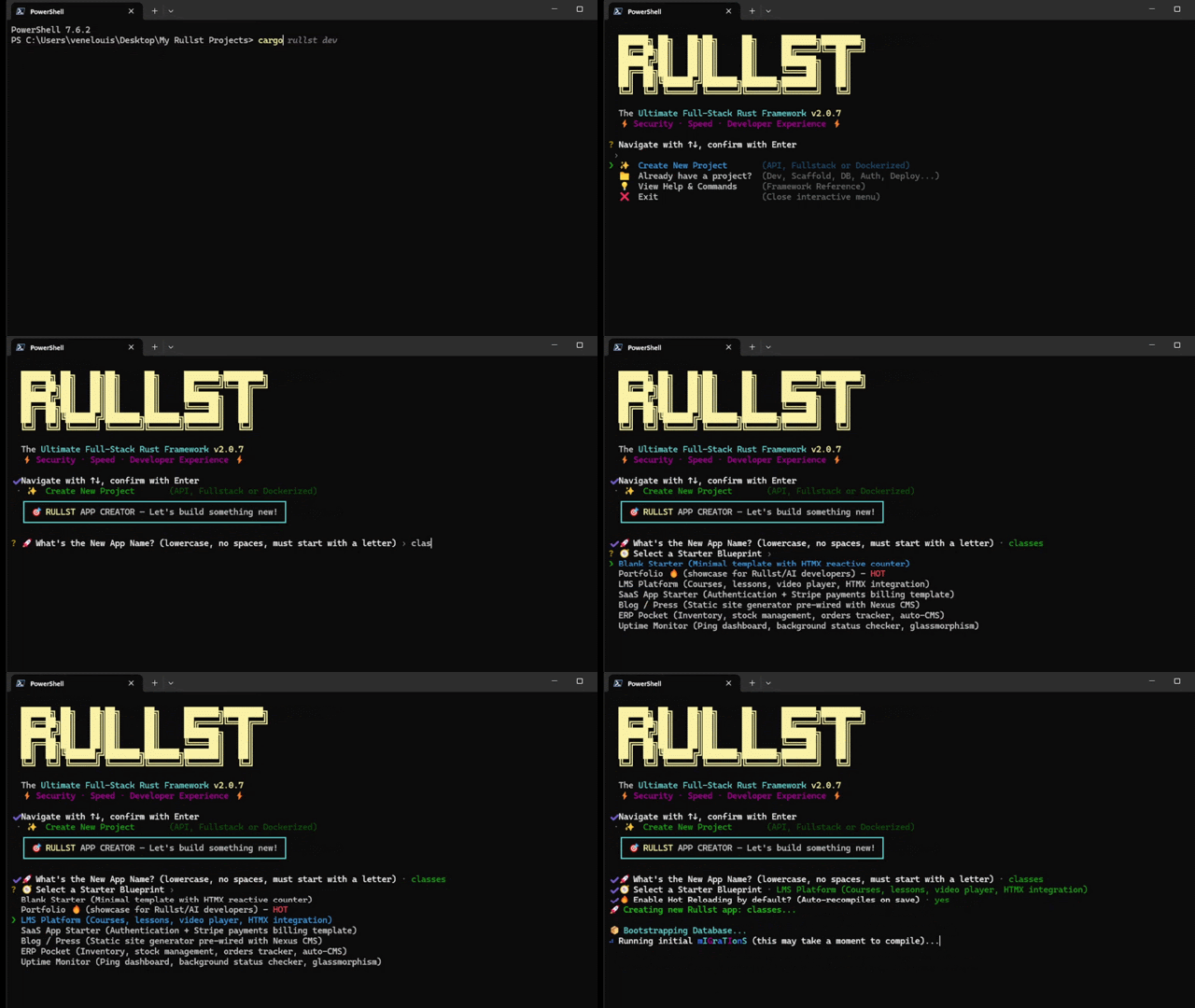

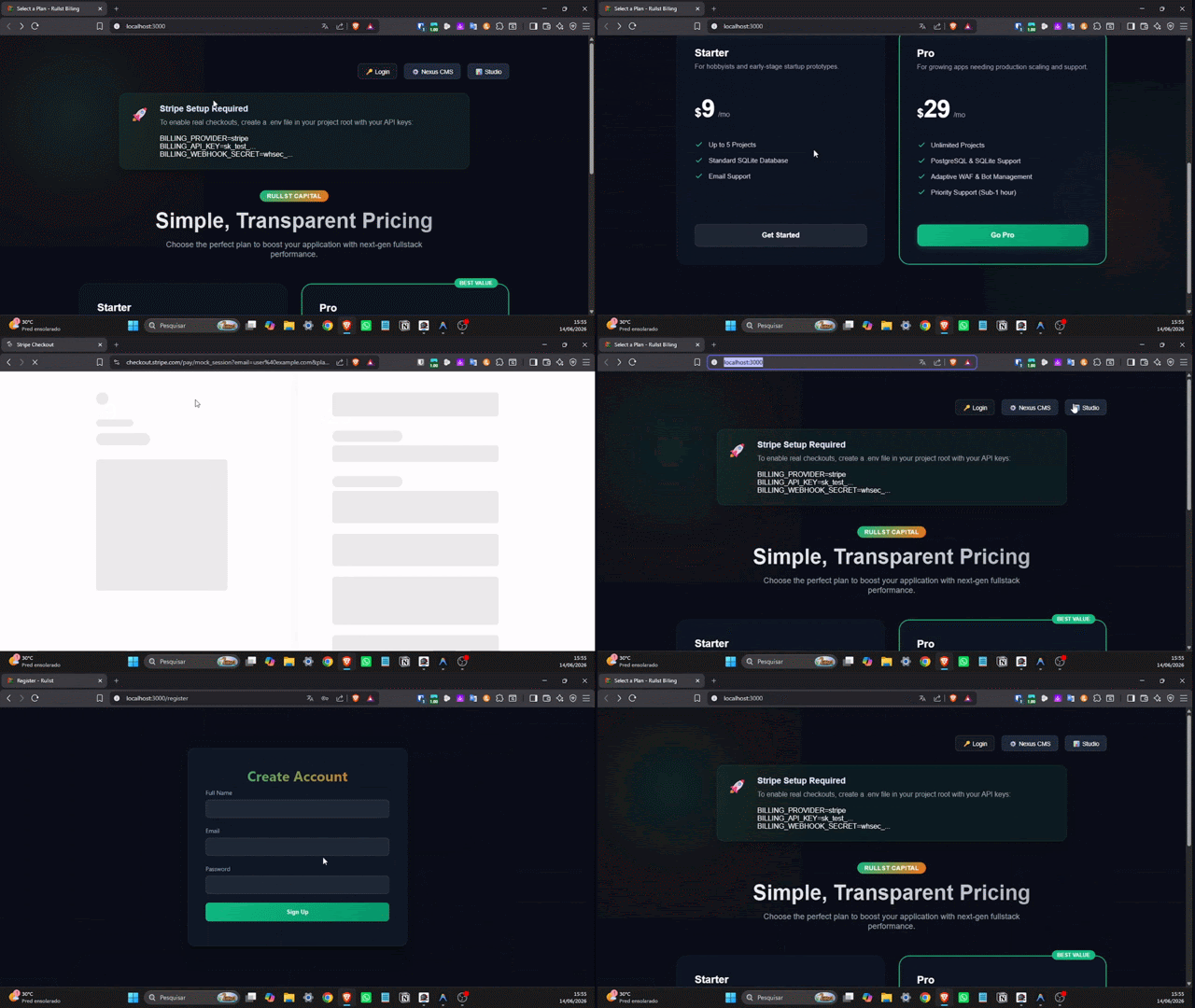
|
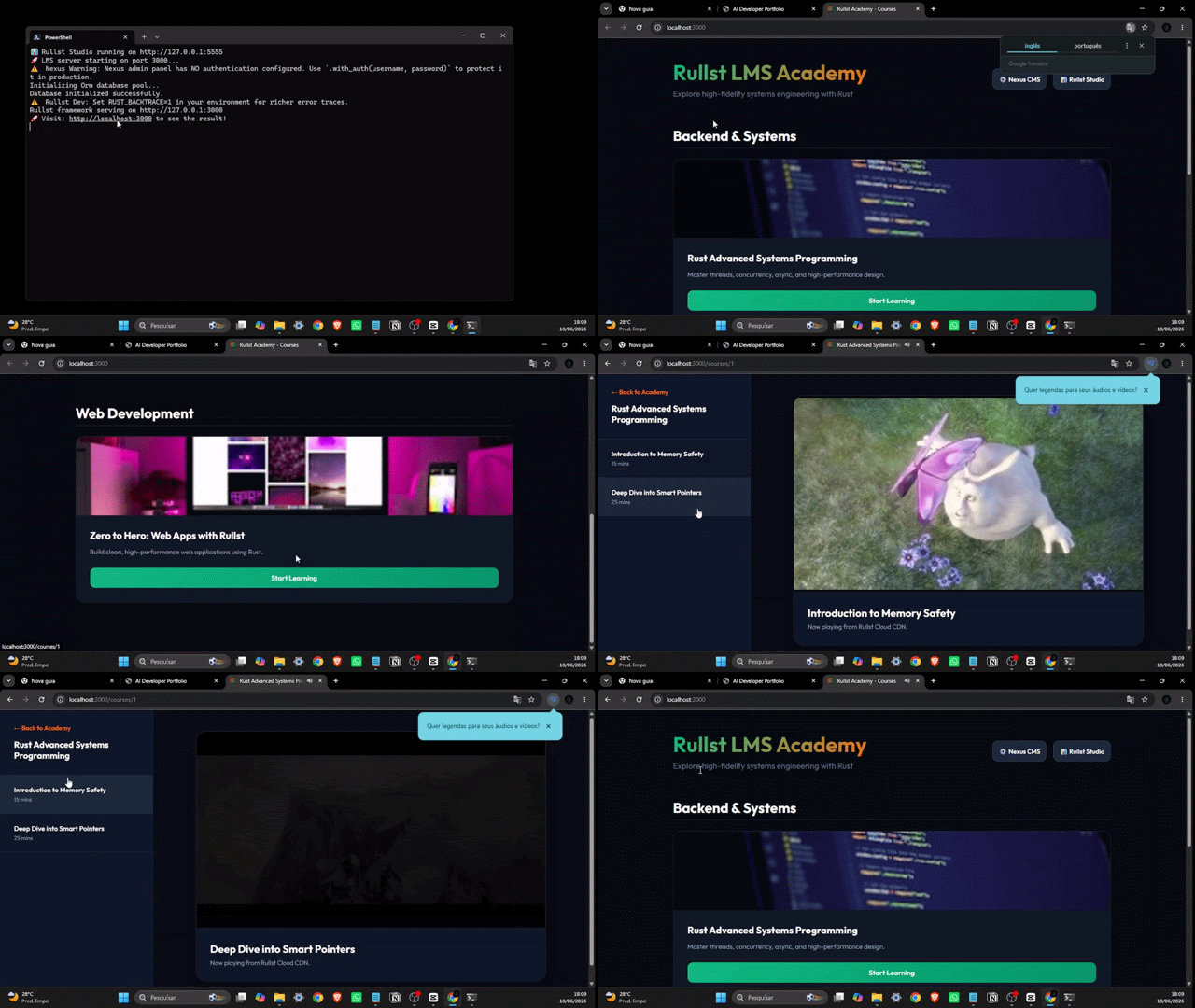
|
Open the development dashboard preview
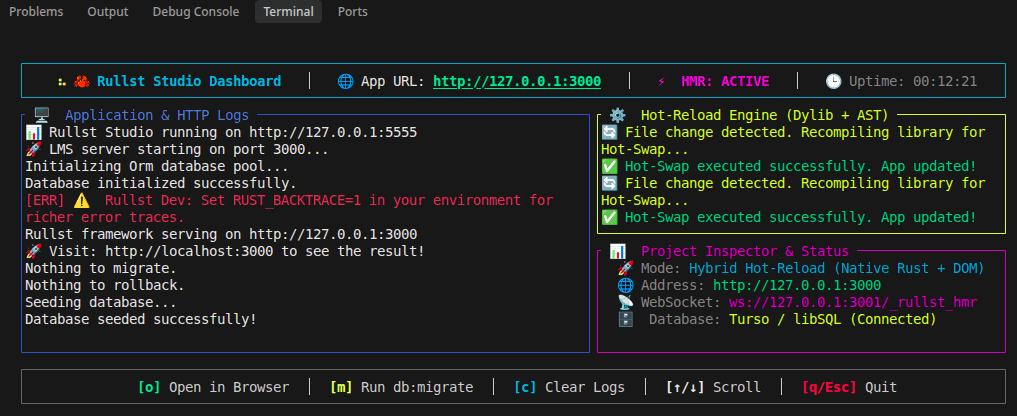
Repository screenshot, not live telemetry. Layout and available controls can differ by version. Development workflow.
From an existing application's root:
cargo rullst upgrade --dry-run
cargo rullst upgrade
The CLI coordinates dependency updates, backs up controlled files and runs compiler checks. Review the plan and application behavior; it does not migrate production data or guarantee compatibility with an unreleased major version.
Assisted upgrade tutorial · v5 → v12 migration guide
Sixteen publishable crates share one release train. Select what your application needs; detailed feature and provider boundaries live in the specification.
Browse the crate directory
| Crate | Focus |
|---|---|
| rullst | Public framework facade and feature selection |
| rullst-core | HTTP runtime, routing, lifecycle and telemetry |
| rullst-orm | Relational models, transactions and capability-specific persistence |
| rullst-auth | Passwords, sessions, passkeys and authorization helpers |
| rullst-security | Defense-in-depth middleware, guards and audit helpers |
| rullst-connect | OAuth2/OIDC identity integrations |
| rullst-ai | Guarded local/cloud clients and tenant-aware retrieval |
| rullst-capital | Payment/payout adapters, webhooks and bounded billing helpers |
| rullst-mail | Transactional email and delivery controls |
| rullst-messaging | Broker-neutral contracts and durable local messaging |
| rullst-studio | Local developer control room |
| rullst-nexus | Registered-model admin with explicit access policy |
| rullst-iot | Bounded no_std helpers and signed OTA verification, not device integration |
| rullst-macros | Compile-time HTML and application macros |
| rullst-orm-macros | Typed ORM code generation |
| cargo-rullst | Project scaffolding, development and upgrade CLI |
The benchmark hub publishes eight Criterion groups backed by nine benchmark binaries. They measure specific workloads and regressions—not universal speed, application throughput or a ranking of frameworks. Read the methodology alongside the results.
Explore the stable release audit, current capability status and quality scorecard. Badges and test results are evidence for their stated scope, not a security certification of every application built with the framework.
🛡️ Open the full v12 verification dashboard (37 workflows)
Rullst applies layered compile, test, architecture, portability, and security checks.
Badges are pinned to the main branch; they report the latest matching run, not a certification or deployment guarantee.
| Continuous or change-aware gate | v12 main status |
Actual scope |
|---|---|---|
| Rust CI |  |
Format, all-target/all-feature Clippy, tests on Linux/macOS/Windows, Cargo-aware doctests sourced from all 52 public tutorials, strict DB boundaries, feature boundaries, generated-code checks, and MSRV 1.96.0. |
| Declared MSRV |  |
Every publishable v12 manifest declares Rust 1.96.0 and CI runs an explicit workspace all-feature check with that toolchain. |
| GitHub Actions lint |  |
Validates workflow syntax, expressions, embedded shell, and full-SHA third-party Action pins. |
| Documentation |  |
Builds the mdBook and rejects broken local links and anchors; scheduled/manual runs also preserve an informational external-link report. |
| End-to-end smoke |  |
Boots the release blog example and verifies HTTP, security headers, form flow, and SQLite persistence. |
| Codecov — whole repository | |
The badge reports the current branch aggregate. The stable-source LLVM run at eb11f892 measured 90.3220% (79,813/88,365 lines) before Codecov upload. The enforced repository floor is ≥90% with zero tolerance. |
| Codecov — framework libraries |  |
Runtime libraries are enforced separately at ≥90%. CLI and proc-macro components stay separately visible; Coverage CI uploads their real LCOV evidence with OIDC. |
| Cargo Audit |  |
RustSec advisory scan with only governed, expiring exceptions. |
| Security exception governance |  |
Cross-checks scanner allowlists against the owner/expiry ledger, then independently reruns Cargo Audit. |
| Cargo Deny |  |
Advisory, license, ban, and source policy. |
| CodeQL SAST |  |
Rust semantic analysis after an all-target/all-feature build. |
| OpenSSF Scorecard |  |
The badge renders the score from the official public Scorecard JSON report; the pinned Scorecard workflow publishes OIDC-authenticated results on each main push and weekly. A score is evidence, not a security certification. |
| Cargo Machete |  |
Unused direct dependency detection. |
| SemVer checks |  |
Supported library APIs are compared with exact latest non-yanked registry baselines; never-published packages and unsupported proc-macro/binary surfaces are reported explicitly. |
| Zero-panics policy |  |
Denies panic-family operations in published production targets and generated runtime templates. |
| Unsafe boundary |  |
Denies new production unsafe code outside the reviewed OS/FFI allowlist. |
| Secret scanning |  |
Verified-secret scan across the configured Git history range. |
| Spellcheck |  |
Repository-wide typo detection. |
| Crate architecture policy |  |
Compares the real publishable-crate dependency graph with a versioned, reviewed repository policy. |
| WebAssembly matrix |  |
Compiles Core, the public facade and macros for browser Wasm and WASI Preview 1. |
Bare-metal no_std matrix |
 |
Builds IoT helpers for Cortex-M and RISC-V targets; this is compile evidence, not hardware testing. |
| IoT integration |  |
Host tests, signed OTA invariants, and a Cortex-M build. |
| IoT crypto containment |  |
Path-aware signed OTA, Vault, advisory, and simulator-boundary checks; no PQC/HSM certification claim. |
| Omni desktop matrix |  |
Generates fresh web shells and checks their Tauri crates on Linux, macOS and Windows; no installer, signing or store claim. |
| Omni Android compile |  |
Generates a fresh shell and compiles an unsigned Android debug APK; no physical-device, Play testing/signing or store claim. |
| Omni iOS simulator |  |
Path-aware fresh scaffold generation and compilation on a macOS iOS simulator target; no device, signing or App Store claim. |
| PR security evidence |  |
Pull-request-only bounded IDOR/RBAC heuristics and CycloneDX SBOM artifact. It intentionally has no continuous main status. |
Deep or irreversible workflows are intentionally not presented as continuously green main gates:
| Deep evidence | Trigger and enforcement |
|---|---|
| Benchmark regression | Weekly, main push, or manual; eight published groups backed by nine Criterion benchmark binaries emit non-blocking alerts at a 20% regression. |
| Property testing | Weekly/manual release-mode invariant testing with 10,000 configured cases. |
| TSan and ASan | Daily/manual package matrices on a pinned verifier-only nightly. |
| Fuzzing / corpus minimization | Forty manual libFuzzer jobs; weekly/manual corpus maintenance is informational. |
| OWASP ZAP | Manual baseline over three release surfaces: generated REST API and complete LMS are blocking with no ignored alerts; the deliberately CDN-backed blog showcase remains an explicitly informational boundary. |
| Kani, Miri, mutation testing, cargo-udeps | Manual or scheduled research signals: selected Kani/Miri scopes are strict, while mutation and unused-dependency findings remain explicitly informational. |
| GitHub Pages | Deploys the v12 documentation from main; it is not a code-quality gate. |
| Release and provenance | Exact version tags only: full verification, package-all, evidence bundle, checksums, GitHub build-provenance attestation, changelog-derived release notes, and ordered crates.io publication. This does not claim a project-wide SLSA level or independent certification. |
Scheduled events use the repository's default branch, so scheduled and
continuous v12 evidence now refer to main. The recommended required-check
profile and the exact scope of all
37 workflow definitions are documented in WORKFLOWS.md.
📖 Read the detailed breakdown of all CI/CD and security workflows.
🧭 Capability Status & Vision Decisions preserves ambitious features that are partial or not implemented, with an explicit recommendation and rationale for each one.
📋 Simple Capability Status and the per-commit quality scorecard keep feature progress separate from SHA-bound engineering evidence.
Try a blueprint, report a reproducible bug, improve a tutorial or contribute a focused change with tests. Documentation, accessibility and integration feedback matter as much as new features.
Contributing · Issues · Discord · Community links · Our story and philosophy
What's next? v12 receives compatible maintenance. The v13 roadmap guides next-major development; planned capabilities are not shipped features.
MIT license · Report a vulnerability privately · Website privacy notice
All glory and honor to God יהוה in the name of Yeshua the Messiah (Jesus Christ).
