

Iceberg is a room auralization method for auditory research, proposed in the PhD thesis of Sergio Aguirre (University of Nottingham, 2023). It reproduces a sound source in a room with as few as four loudspeakers on a horizontal ring. This repository is its C++ implementation, a library and a standalone app for macOS, Windows and Linux, which reproduces the reference MATLAB implementation (aguirreSL/Iceberg, v1.0.0) to the rounding of 32-bit floats. No MATLAB license is needed to use it.

The latest version, for each system (older versions and the release notes are on the Releases page):
- macOS (Apple silicon and Intel): Iceberg-macos.zip.
Unzip and move
Iceberg.appto Applications. The app is not signed by Apple yet, so the first time it has to be opened with a right-click and Open, then Open again. - Windows: Iceberg-windows-installer.exe. If SmartScreen warns, choose More info, then Run anyway.
- Linux: Iceberg-linux.tar.gz.
Unpack and run
Iceberg.
Playback needs one audio output per loudspeaker (four for the default ring). On a laptop, Prep mode plays any stimulus in stereo on headphones.
People with hearing loss are challenged most in noisy social settings, and testing them in such conditions usually requires a large laboratory. With few loudspeakers, the common reproduction methods trade one quality for another: first-order Ambisonics conveys the envelopment of a room but blurs the localization of the source, whereas vector base amplitude panning (VBAP) localizes sharply but conveys little of the room. Iceberg combines the two, so that a listening test in a reverberant room can be run with minimal hardware.
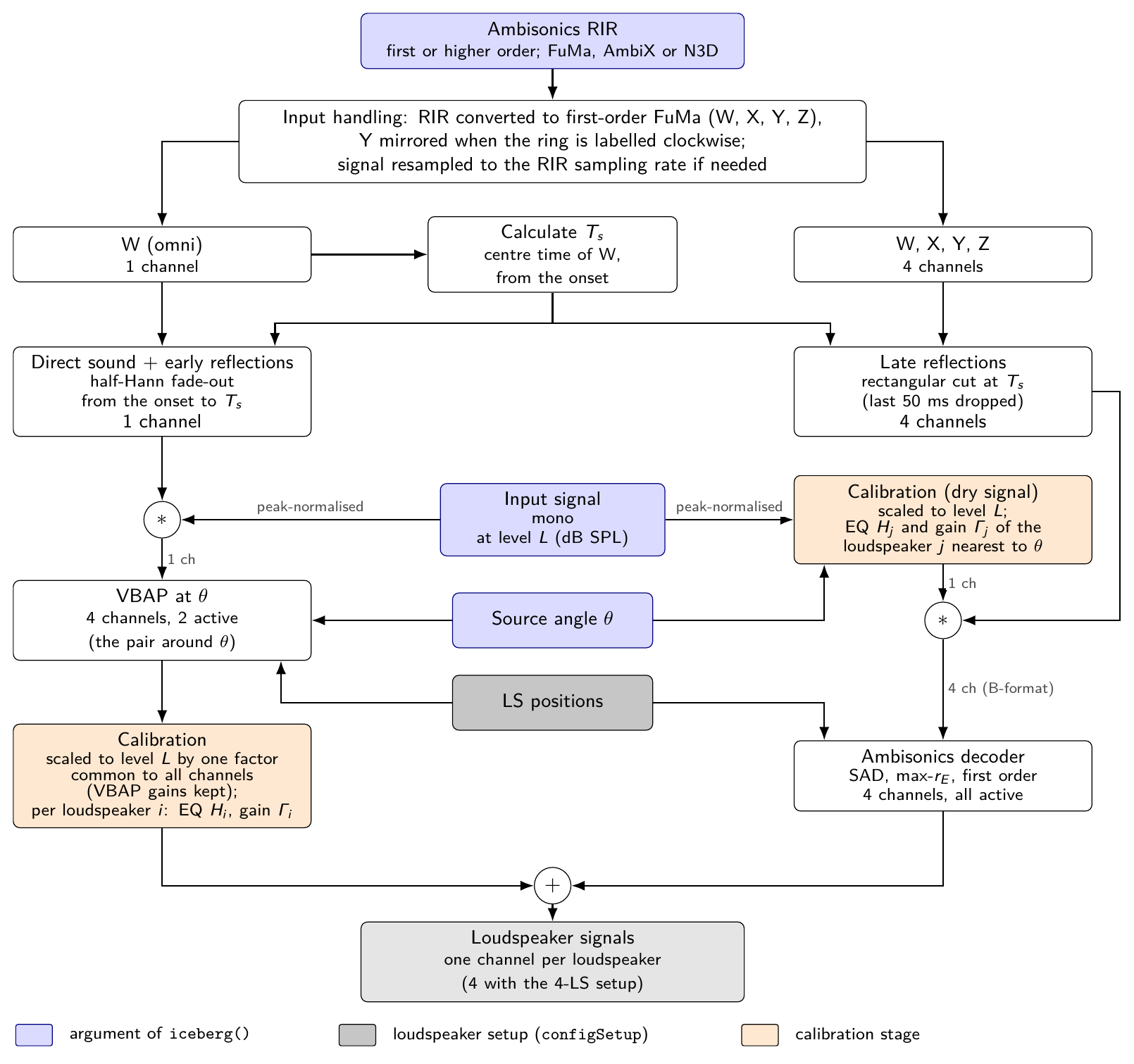
The room is described by its impulse response (RIR) in Ambisonics B-format, simulated
(e.g., the B-format output of ODEON) or measured. Iceberg splits the RIR at its centre
time (
- The direct sound and the early reflections, up to
$T_s$ , are rendered with VBAP, for localization. - The late reverberation, after
$T_s$ , is rendered with first-order Ambisonics, for envelopment.
The stimulus is convolved with both parts, which pass through the calibration of the reproduction room (1/3-octave filters and a level alignment per loudspeaker) and are summed on the loudspeakers.
A test session is built as a list of stimuli. Each stimulus is a recording (e.g., a
sentence of a speech test) placed at an angle in a room, and it is played at a level in dB
SPL when a calibration of the reproduction room is loaded, or in dBFS without one. The list
plays in order, with a fixed pause between stimuli or waiting for the operator, and the
settings of the session are saved as one .iceberg-exp file. Prep mode plays any stimulus
in stereo on headphones, so that a session can be prepared away from the loudspeakers.
Iceberg does not ship speech material; any recording can be used. Each stimulus has one source, and scenes with several simultaneous sources (e.g., a talker and a masker at different angles) are not supported in the app yet. Two stimuli can still be presented together by summing their exported renders in other software.
The app runs on a laptop without MATLAB. The position pad lights the loudspeaker pair that
VBAP pans the source on, and Live mode moves the source while it plays, which can be heard
on headphones in Prep mode. Every render can be exported as a WAV file with one channel per
loudspeaker, for analysis in other software. Three simulated rooms, with reverberation
times of 0, 0.5 and 1.1 s, are available in the Iceberg MATLAB repository
(src/wavFiles/rt_00, rt_05, rt_11) as a starting point; the anechoic one is rendered
with Anechoic case on.
The renderer accepts B-format RIRs of any order in the FuMa, AmbiX and N3D conventions,
reduced to first order, and loudspeaker azimuths counted in either direction. Rings of more
than four loudspeakers are described with a layout file, and layouts of 8 and 24
loudspeakers are among the tested cases. Moving sources are available in two experimental
forms: a source dragged on the pad while it plays, and a trajectory of time:angle points
rendered offline. The library is C++17 with a short API, described in
docs/DEVELOPING.md.
This is version 0.2.0 (beta), the first public version.
- The static render matches Iceberg MATLAB v1.0.0 to the rounding of 32-bit floats,
including the input handling (Ambisonics conventions and orders, the azimuth convention,
resampling) and the loudspeaker layouts. Over a 5-degree sweep of 216 renders in three
rooms the differences stay within 1.5e-9 RMS and 1.6e-7 of the peak, and the 8- and
24-loudspeaker layouts likewise. The reference data, with the MATLAB script that made
them, are published on Zenodo
(doi:10.5281/zenodo.23543831);
scripts/get_fixtures.shdownloads them, and the tests then repeat the comparison. - The method was evaluated in the thesis with objective measures: binaural cues in three simulated rooms and a psychoacoustic model of spatial accuracy, with and without hearing aids. That evaluation used the 2020 implementation, whose level stage differs from v1.0.0 (see the Iceberg MATLAB README). Validation with participants was not possible during the COVID-19 pandemic, and Iceberg has not been evaluated in listening tests yet. It is intended for research and is not certified as a medical device.
- Experimental: the room calibration by measurement (Calibration > Calibrate room). It
matches MATLAB within 1e-11 on simulated devices and has not been run on real hardware.
Loading a
calibration.jsonmeasured with Iceberg MATLAB is the tested path. - Experimental: moving sources. Held still, they reproduce the static render (222 renders); a moving source has no MATLAB counterpart.
- 211 library tests. On an Apple M4 Pro, one render of the default stimulus takes 38 ms for 1 s of signal, 1.5 s for 30 s, 2.0 s for 1 min and 27 s for 10 min.
Every control has a tooltip. In short:
- A slot is one stimulus: an impulse response (B-format WAV), a signal, a source angle and a level. The signal can be a WAV, AIFF or FLAC file, which keep it exact, or Ogg Vorbis or MP3 (MP3 on macOS and Windows), whose encoders change the signal; MP3 also delays its start by a few milliseconds. Without a layout file it renders on four loudspeakers at 0, 90, 180 and 270 degrees, counter-clockwise (90 is on the left), and the channel menus set which output each one uses.
- With Use full scale on, the level is in dBFS and no room calibration is applied. With
it off, a
calibration.jsonis loaded and the level is in dB SPL. - Render this slot renders the stimulus and Play this plays it; Play sequence plays
every rendered slot in order. File > Save keeps the experiment as an
.iceberg-expfile. - Live, next to Prep mode, turns Play this into Play live: the source follows the pad while it plays.
- A trajectory is typed as
time:anglepoints, or built by dragging the source and pressing Add point. Render trajectory and Play trajectory render and play the moving source, and the list of stimuli marks the slot with a spiral. - File > Export ... (WAV) writes a render to disk as 32-bit float, one channel per loudspeaker.
The app follows the light or dark appearance of the operating system; View > Appearance fixes one of them instead.
Without a layout file, a stimulus renders on four loudspeakers at 0, 90, 180 and 270 degrees. Other rings are described in a JSON file, loaded in the slot's layout file row, in one of two formats. Angles are in degrees, counter-clockwise by default (0 in front, 90 on the left), and elevations are 0, since the ring is horizontal. A calibration file has one entry per loudspeaker position of the layout.
A list of loudspeakers, all in use, in the order of the outputs (examples/layouts/ring8_speakers.json):
{
  "speakers": [
    {"label": "front",      "azimuth": 0,  "elevation": 0},
    {"label": "front-left", "azimuth": 45, "elevation": 0},
    ...
  ]
}
A ring as in Iceberg MATLAB's configuration, where every position is an output and only
the listed ones play (examples/layouts/ring24_4active.json).
lsArray holds the azimuth of each position, activeLSNumbers the positions in use
(counted from 1) and ls_dir their azimuth and elevation:
{
  "lsArray": [180, 195, 210, ..., 150, 165],
  "activeLSNumbers": [1, 7, 13, 19],
  "ls_dir": [[180, 0], [270, 0], [0, 0], [90, 0]]
}
examples/calibration holds the example calibration shipped with Iceberg MATLAB in two
forms: ring24.json for the 24-position layout above, and four_loudspeakers.json for
the default four loudspeakers (0, 90, 180 and 270 degrees on outputs 1 to 4). They show
the format and let a stimulus be rendered in dB SPL; a real room needs its own calibration
(Calibration > Calibrate room, or Iceberg MATLAB).
Clone with git clone --recursive to get JUCE, which the app uses. The library needs
CMake and Eigen. The steps, the code layout and the library API are in
docs/DEVELOPING.md; the conventions for contributors are in
CONTRIBUTING.md. Questions and bug reports are welcome in the GitHub
issues.
If you use Iceberg, please cite the thesis (PDF):
@phdthesis{aguirre_2023,
  title  = {Iceberg: a loudspeaker-based room auralization method for auditory research},
  author = {Aguirre, Sergio Luiz},
  school = {University of Nottingham},
  year   = {2023},
  month  = jul,
  url    = {https://repository.nottingham.ac.uk/handle/123456789/58572}
}The C++ code reimplements Iceberg MATLAB, which is built on Archontis Politis'
Vector-Base-Amplitude-Panning
and Higher-Order-Ambisonics
toolboxes (with Ville Pulkki's vbap()), and it replicates the numerics of the
ITA-Toolbox (RWTH Aachen) that Iceberg uses. The
app is built with JUCE.
The port was written with Claude (Anthropic's AI assistant), under the direction and review of Sergio Aguirre. Its correctness rests on the comparison with the MATLAB reference: every stage and every render is tested against data that Iceberg MATLAB generates (the numbers above), and what has no MATLAB counterpart is labelled experimental.
The functions that reproduce the numerics of the ITA-Toolbox were written as a clean-room implementation. Each one was first described in a written specification, based on the published methods (ISO 3382-1, Lundeby et al. 1995, Kirkeby and Nelson) and on the behaviour that Iceberg requires, without any source code. A separate Claude session then implemented it from that specification alone, with no access to the ITA-Toolbox source, to the Iceberg MATLAB files that replicate it, or to any earlier implementation. These functions cover the onset and the centre time of the impulse response, the time windows and the convolution of the render, and the signal processing of the room calibration. The specifications are in docs/cleanroom, and the functions are compared with Iceberg MATLAB in the same way as the rest of the port.
The library, the tests and the build files are under the BSD 3-Clause License
(LICENSE), as Iceberg MATLAB is. The app in apps/iceberg-juce is under the GNU
Affero General Public License, version 3 only (AGPL-3.0-only,
apps/iceberg-juce/LICENSE), because it is built with JUCE,
whose open-source licence is the AGPLv3. The third-party
components keep their own licences: JUCE (AGPLv3 or commercial), Eigen (MPL 2.0),
nlohmann/json (MIT), pocketfft (BSD 3-Clause) and GoogleTest (BSD 3-Clause, tests only).
THIRD_PARTY_NOTICES.txt, which every package carries, gives
their full texts, with those of the libraries JUCE builds into the app and of the MATLAB
toolboxes whose algorithms the library reproduces.