



A demo banking assistant that combines vector RAG, a LangGraph multi-agent pipeline, and runtime-switchable LLM providers — all backed by a single CockroachDB cluster.
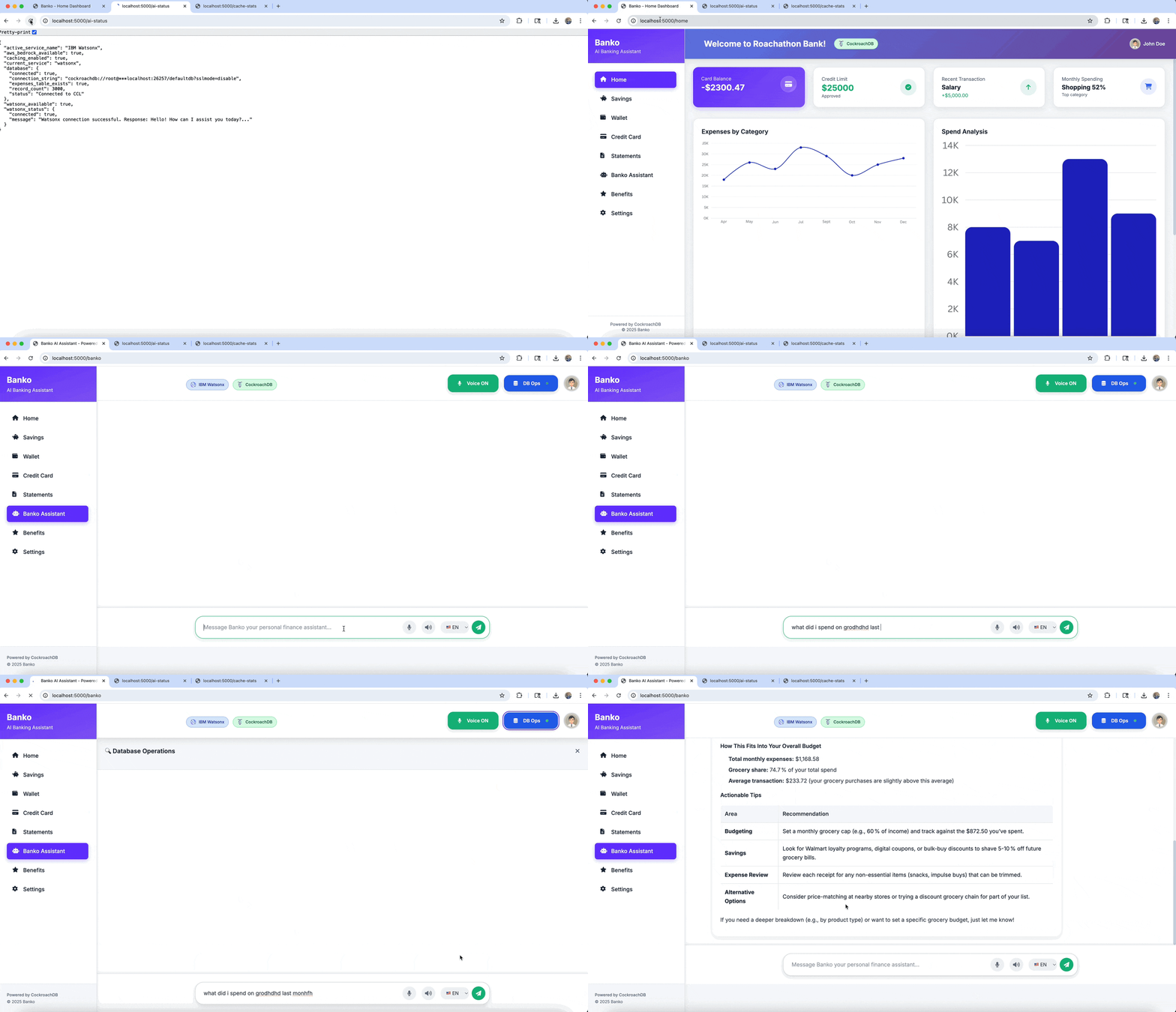
- Ask in natural language — "what did I spend on dining last month?", "show me anything unusual" — answers come from vector search over your expenses plus an LLM-generated summary.
- Upload a receipt — image or PDF goes through an OCR + agent pipeline
(
Receipt → Fraud → Budget) that extracts items, flags duplicates, and reports budget impact, with each agent step durably checkpointed. - Multi-provider LLM — watsonx (default), OpenAI, AWS Bedrock, or
Google Gemini. The provider is chosen at startup via
AI_SERVICE; within a running app you can swap models inside the active provider from Settings (model lists come from each provider's API, not a hardcoded enum). Switching providers requires a restart with the new env value. - See agents work in real time — the dashboard streams actual agent state from the backend (no canned activity).
- Persistent chat — conversations survive restarts via
CockroachDBChatMessageHistory. - Three-layer semantic cache — query / embedding / vector-search caches with tunable similarity thresholds.
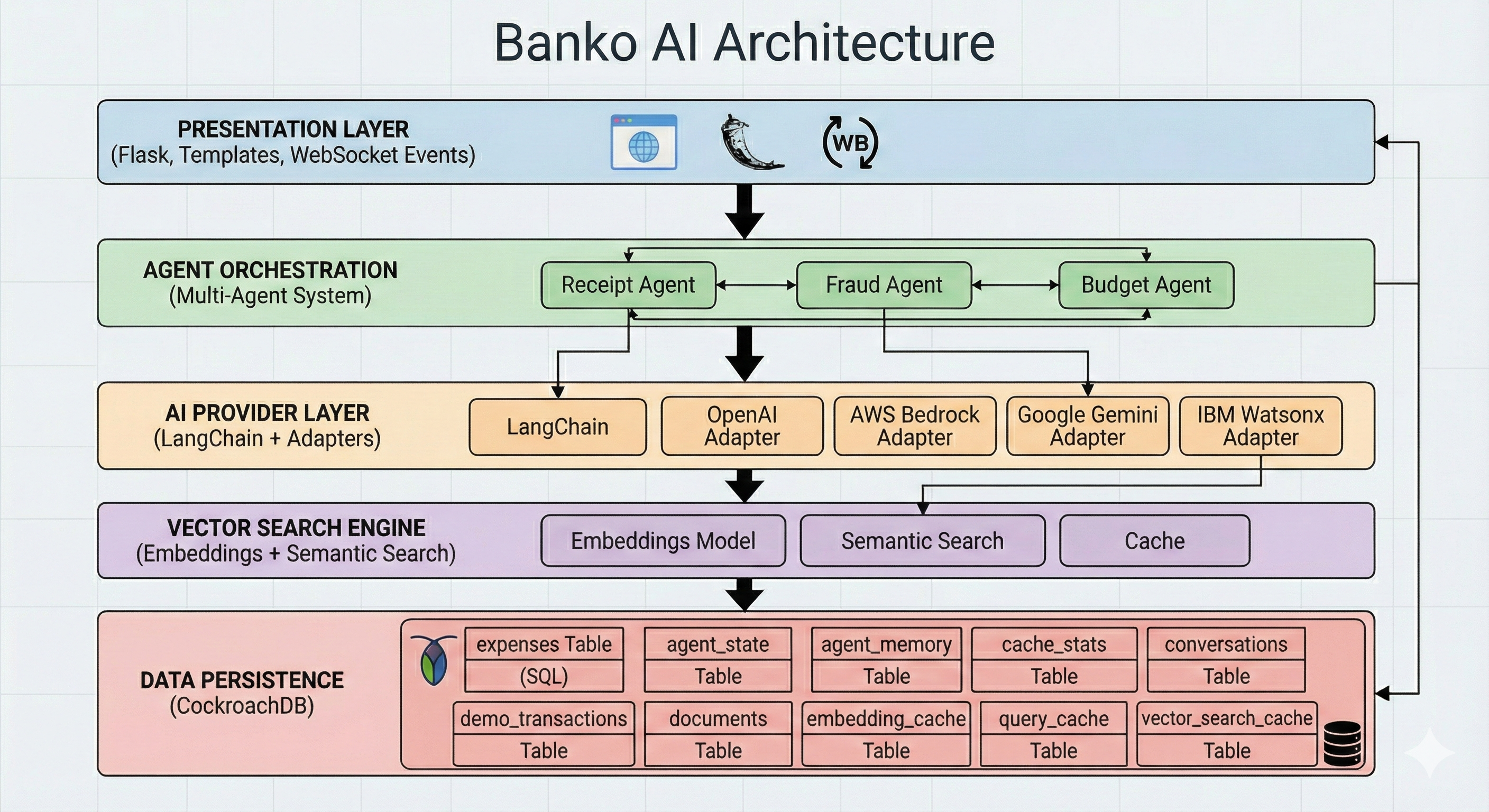
Five layers, one database:
| Layer | What it does | Where |
|---|---|---|
| Web | Flask + SocketIO UI, REST API, real-time agent status | banko_ai/web/ |
| Agents | LangGraph pipeline (Receipt → Fraud → Budget), checkpointed by CockroachDBSaver for crash recovery and replay |
banko_ai/agents/ |
| AI providers | One abstraction over watsonx, OpenAI, Bedrock, Gemini — all LLM calls go through it | banko_ai/ai_providers/ |
| Vector search | CockroachDBVectorStore with C-SPANN cosine indexes, 384-dim all-MiniLM-L6-v2 embeddings (local, no API key) |
banko_ai/vector_search/ |
| Persistence | CockroachDB stores SQL rows, vectors, and agent state in one cluster | banko_ai/utils/ |
All CockroachDB-specific pieces come from
langchain-cockroachdb:
CockroachDBEngine (psycopg3 pool), CockroachDBVectorStore,
CockroachDBChatMessageHistory, and CockroachDBSaver.
- Python 3.10+ (3.12 recommended)
- CockroachDB v25.4.0+ (vector indexes are GA)
- An API key for at least one provider (watsonx, OpenAI, AWS, or Gemini), or a local model through Ollama (no key, no internet)
pip install banko-ai-assistant            # PyPI
# or
docker-compose up -d                      # Docker
# or
git clone https://github.com/cockroachlabs-field/banko-ai-assistant
cd banko-ai-assistant
uv pip install -e ".[dev]" # local developmentbrew install cockroachdb/tap/cockroach # macOS
cockroach start-single-node --insecure \
--store=./cockroach-data \
--listen-addr=localhost:26257 \
--http-addr=localhost:8080 --backgroundEverything below assumes CockroachDB on localhost:26257 (that is the
built-in default, so DATABASE_URL can be omitted; set it to point
anywhere else). Two optional extras for any of them:
CDC_WEBHOOK_HMAC_SECRET=<any shared secret> turns on the Coach webhook
and the signup welcome nudge, and TOKENIZERS_PARALLELISM=false only
silences a harmless HuggingFace warning.
Installed CLI (pip install banko-ai-assistant):
# Ollama — local model, no keys; needs `ollama serve` running
AI_SERVICE=ollama banko-ai run

# watsonx (the default provider, AI_SERVICE not needed)
WATSONX_API_KEY=... WATSONX_PROJECT_ID=... banko-ai run

# OpenAI — or any compatible endpoint via OPENAI_BASE_URL
AI_SERVICE=openai OPENAI_API_KEY=sk-... banko-ai run

# AWS Bedrock — note aws, not bedrock; a profile OR a key pair
AI_SERVICE=aws AWS_PROFILE=your-profile banko-ai run
AI_SERVICE=aws AWS_ACCESS_KEY_ID=... AWS_SECRET_ACCESS_KEY=... banko-ai run

# Gemini — Vertex service account OR the Generative AI API key
AI_SERVICE=gemini GOOGLE_PROJECT_ID=... GOOGLE_APPLICATION_CREDENTIALS=sa.json banko-ai run
AI_SERVICE=gemini GOOGLE_PROJECT_ID=... GOOGLE_API_KEY=... banko-ai run
From source — identical variables, uv run in front:
git clone https://github.com/cockroachlabs-field/banko-ai-assistant
cd banko-ai-assistant && uv sync
AI_SERVICE=ollama uv run banko-ai run
Docker — identical variables via -e, plus two container facts:
host services are reached at host.docker.internal, and SECRET_KEY
keeps sessions across container restarts (newer images generate a
temporary one when it is omitted):
docker run --rm -p 5000:5000 \
  -e DATABASE_URL="cockroachdb://root@host.docker.internal:26257/defaultdb?sslmode=disable" \
  -e AI_SERVICE=ollama -e OLLAMA_HOST=http://host.docker.internal:11434 \
  -e SECRET_KEY=pick-something-stable \
  virag/banko-ai-assistant:latest
Swap the AI_SERVICE line and credentials for any provider above; only
Ollama needs the OLLAMA_HOST override.
Useful flags for every mode: banko-ai run --port 5001 (macOS AirPlay
holds 5000), banko-ai run --no-data (skip the sample-data generator;
the first normal start generates 5000 sample records).
Open http://localhost:5000.
The first visit asks for a username. New names pick a spending style (diner, subscriber, saver, balanced) and get a seeded history in that style, embeddings included; returning names land straight back in their own data, and the Coach greets new users with a real nudge within seconds. Everything on screen is scoped to that identity: SQL aggregations filter by your user id, vector search runs through the per-user vector index, and the header shows who is signed in. Questions that ask for totals or counts ("how much did I spend on restaurants in the past 60 days?") are answered by SQL directly, so the figures are exact and identical no matter which AI provider is active; the model adds the narrative and suggestions around them. Every answer wears a badge with the real database time, and an expandable panel shows the actual EXPLAIN ANALYZE that produced it.
On a multi-region cluster the same app goes region aware with no extra
configuration: signup offers a home region (detected live from the
cluster), rows are pinned to it via REGIONAL BY ROW, reads prune to the
user's partition, and the answer badge names the regions that actually
served each query. Kill a region and the badge visibly moves to the
survivors while answers keep flowing. Single-region deployments see
none of this; nothing fake is ever rendered. The legacy personas
(maya, sam, riley) still exist for existing databases, and
banko-ai clear-demo-users resets a demo machine while keeping them.
banko-ai --help lists the rest (generate-data, clear-data, status,
search, etc.). The first run creates the schema (expense, agent, cache,
checkpoint tables), generates sample data with embeddings, and initializes
the selected provider.
The whole stack runs without internet: embeddings are computed locally, and the LLM is a local model served by Ollama. Bring the stack up once while online and it preloads itself (an init container pulls the Ollama model into a named volume, skipping the pull when it is already cached); every start after that works with the network off:
docker compose -f docker-compose.airgap.yml up -d # first run online, then works offlineTo cache ahead of time instead (say, the night before a talk),
scripts/airgap/preload-models.sh pulls the same models explicitly.
Default model is granite3.3:8b (override with OLLAMA_MODEL). For a
non-Docker setup, ollama serve plus AI_SERVICE=ollama banko-ai run
does the same thing. Any OpenAI-compatible endpoint also works via
OPENAI_BASE_URL with AI_SERVICE=openai.
The important knobs:
| Variable | Description | Default |
|---|---|---|
DATABASE_URL |
CockroachDB connection string | cockroachdb://root@localhost:26257/defaultdb?sslmode=disable |
AI_SERVICE |
watsonx, openai, aws, gemini, or ollama |
watsonx |
SECRET_KEY |
Flask session key. Auto-generated per boot in dev, which signs everyone out on restart; set it for stable demo sessions | random |
CDC_WEBHOOK_HMAC_SECRET |
Signs Coach webhook posts; unset disables /api/cdc/signals and the welcome nudge |
unset |
Per-provider credentials are in "Start the app" above; AWS_REGION
defaults to us-east-1. Override model lists with WATSONX_MODELS, OPENAI_MODELS, AWS_MODELS,
GEMINI_MODELS (comma-separated). Cache, fraud, and pool tuning live in
banko_ai/config/ (CACHE_SIMILARITY_THRESHOLD, CACHE_TTL_HOURS,
FRAUD_DUPLICATE_WINDOW_DAYS, DB_POOL_SIZE, …).
| Endpoint | Method | Purpose |
|---|---|---|
/api/health |
GET | DB + AI status |
/api/ai-providers |
GET | List providers |
/api/models |
GET / POST | List or switch models |
/api/search |
POST | Vector search |
/api/rag |
POST | RAG-based Q&A |
/api/upload-receipt |
POST | Run a receipt through the agent pipeline |
/api/agents/status |
GET | Agent dashboard data |
/api/chat-history/<id> |
GET / DELETE | Persistent chat per session |
Full list with examples in docs/API.md. Quick check:
curl -X POST http://localhost:5000/api/rag \
  -H "Content-Type: application/json" \
-d '{"query": "What are my biggest expenses this month?"}'Everything above waits for a question. The Coach reacts to events: a
spending signal arrives, an agent investigates with real budget and
transaction tools, and a nudge appears live on the /coach tab, for
example "you've used 82% of your dining budget with 9 days left." Signals
and nudges live in CockroachDB with row-level TTLs, and the agent's
conversation state checkpoints there too.
Kick it off the quick way, by posting a synthetic signal at the webhook:
export CDC_WEBHOOK_HMAC_SECRET=dev-only-secret   # same value as the app
uv run python scripts/coach/mock_signals.py --type=budget_threshold
# also: --type=anomaly, --type=recurring_drift
The coach page shows the signed-in user's nudges. By default the script
targets the maya persona, so sign in as maya to watch the nudge land,
or pass --user-id (or set COACH_DEFAULT_USER_ID) for the account you
signed up with.
Or run the real thing: CockroachDB changefeeds streaming through Debezium
and Kafka into the app. One script brings up Kafka, Kafka Connect, and the
Debezium CockroachDB connector, then registers a source on the
spending_signals table:
scripts/coach/cdc-demo/run-cdc-demo.sh
# then run the app with the Kafka transport on:
COACH_KAFKA_ENABLED=true KAFKA_BOOTSTRAP_SERVERS=localhost:29092 \
  AI_SERVICE=watsonx banko-ai run
With that stack up, sending a change event is just SQL. Insert a row and CockroachDB streams it to the Coach, no webhook involved. The coach page shows the signed-in user's nudges, so target the username you signed up with:
INSERT INTO spending_signals
  (user_id, signal_type, severity, payload, idempotency_key)
VALUES
  ((SELECT user_id FROM users WHERE username = 'YOUR-USERNAME'),
   'budget_threshold', 'warn',
   '{"category": "dining", "pct_used": 0.82, "monthly_budget": 400.0,
     "spent_so_far": 328.0, "days_remaining": 9}',
   'demo:' || gen_random_uuid()::STRING);
Watch /coach while you run it. To verify the whole path automatically:
uv run python scripts/coach/assert_nudges.py             # webhook transport
uv run python scripts/coach/assert_nudges.py --via sql   # the CDC pipeline
The producer contract (payload shapes, idempotency, both transports) is in PIPELINE_CONTRACT.md.
This repo is the agent side. A companion repo,
viragtripathi/cockroachdb-watsonx-data-pipeline,
streams CockroachDB CDC events into Apache Iceberg on IBM watsonx.data
(both via webhook and Debezium → Kafka). Neither repo requires the other —
this app works against a local CockroachDB with its own sample data — but
the two together demo the end-to-end transactional + lakehouse path.
python -m pytest tests/ -v                # all tests
ruff check banko_ai/                      # lint
Integration tests need a populated CockroachDB; they're skipped in CI when the DB isn't available.
- CockroachDB version — must be v25.4.0+ for vector indexes
(
cockroach version). - DB connection error — confirm the single-node command above is
running, then
cockroach sql --insecure --execute "SHOW TABLES;". - AI provider issues — confirm keys are exported, then hit
/api/health. For watsonx,/diagnostics/watsonxhas connection details. - Port 5000 in use (macOS) — AirPlay Receiver claims port 5000.
Either disable it in System Settings → AirDrop & Handoff, or run
banko-ai run --port 5001.
MIT