by Maria Marta Santos and Hugo Gamboa
###Physiological Principal
A motor neuron receives an electrical signal form the Central Nervous System, which is transmitted through motor fibers and a skeletal muscle contraction occurs. The signal is transmitted by diffusion, generating a cascade of electrophysiological and physiological events - nervous impulse. [1], [2]
###Sensor working principle
To obtain an EMG signal is necessary to monitor muscle activation. Therefore, two electrodes are positioned on the skin over the muscle of interest, in order to measure the difference of potential between them and acquire and amplify the signal. [1], [3] This is preferred to the more invasive method of insert needle electrodes into the muscle. [4]
-
Prepare. Remove hair, dead skin and oils using a lightly abrsive and rubbing material with alcool at the electrodes sites. Select a place without muscle int he skin to place the ground electrode.
-
Connect. Place the surfaces on the midline of the belly of with an inter-electrode space of ~2cm oriented paralell to the direction of the muscle fibers.
-
Acquire. Make some movements. Visualize the signals in open signals
-
baseline shifts: After each burst a regular EMG signals returns to 0. Shifts may occurr if the ground is not used, the surfaces are loose or not touching at all.
-
baseline noise: Increased baseline noise may appear when the detection surfaces touch each other or the skin have not been correctly prepared.
-
ECG artifacts: when acquiring near the heart ECG bursts may contaminate the EMG signal
###The signal - Image
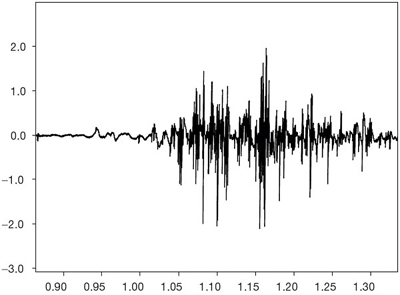
Examples of sEMG signal recorded. [5]
- Frequency band: 25HZ to 450Hz
- Amplitude: 1mV
- Noise imunity (snr): ~90dB
###Features
- activation intensity
- contraction’s duration
- variability
- biofeedback information
- Mean Absolut value;
- Zero-crossing
- Slope sign changes
- Waveform length
- Willison amplitude
- Variance
- v-Order
- Autoregression coefficients
- others [6],[7]
- Signal-to-noise ratio
- Spectral moments
- Frequency ratio
- Total power
- others [6],[7]
###Signal processing algorithms
Low level processing:
Time-domain:
- Rectification (half wave or full wave)
- Filters (butter band pass filter of 30 – 2000 Hz)
Frequency domain
- Frequency spectra (FFT analysis) [1]
Higher level processing
- Coherence
- Phase Locking Factor
- Wavelet analysis [1],[2]
###Use cases
- neurology
- rehabilitation
- orthopedics (example: EHW chip development for prosthetic hand control)
- ergonomics
- sports
- diagnostic tool [2],[3]:
- neuromuscular diseases
- low back pain assessment
- kinesiology
- disorders of motor control
###References
[1] Camara, Mafalda (2013) Coherence and Phase Locking Disruption in Electromyograms of Patients with Amyotrophic Lateral Sclerosis - Dissertation to Obtain Master Degree in Biomedical Engineering, Faculdade de Ciências e Tecnologia da Universidade Nova de Lisboa
[2] Reaz, B. I., Hussain, M. S., Mohd-Yasin, F. (2006) Techniques of EMG signal analysis: detection, processing, classification and applications, Biol. Proced. Online 2006; 8(1): 11-35.
[3] Plux Wireless Biosignals SA - catalog
[4] Siriprayoonsak, Saksit (2005) Real-Time Measurement of Prehensile EMG Signals, San Diego State University
[5] Merletti, Roberto; Botter, Alberto; Troiano, Amedeo; Merlo, Enrico; Minetto, Marco Alessandro (2009) Technology and instrumentation for detection and conditioning of the surface electromyographic signal: State of the art, Clinical Biomechanics 24. 122–134
[6] Tkach, Dennis; Huang, He; Kuiken, Todd A (2010) Study of stability of time-domain features for electromyographic pattern recognition. Tkach et al. Journal of NeuroEngineering and Rehabilitation. 7:21
[7] Phinyomark, Angkoon; Quainea, Franck; Charbonniera, Sylvie; Servierea, Christine; Tarpin-Bernardb, Franck; Laurillaub, Yann. EMG Feature Evaluation for Improving Myoelectric Pattern Recognition Robustness