Note
This tutorial ties in with the NVIDIA Sim-to-Real SO-101 learning course and its workshop repository, which present a broader end-to-end physical AI workflow with the SO-101, Isaac Lab, and NVIDIA Isaac GR00T.
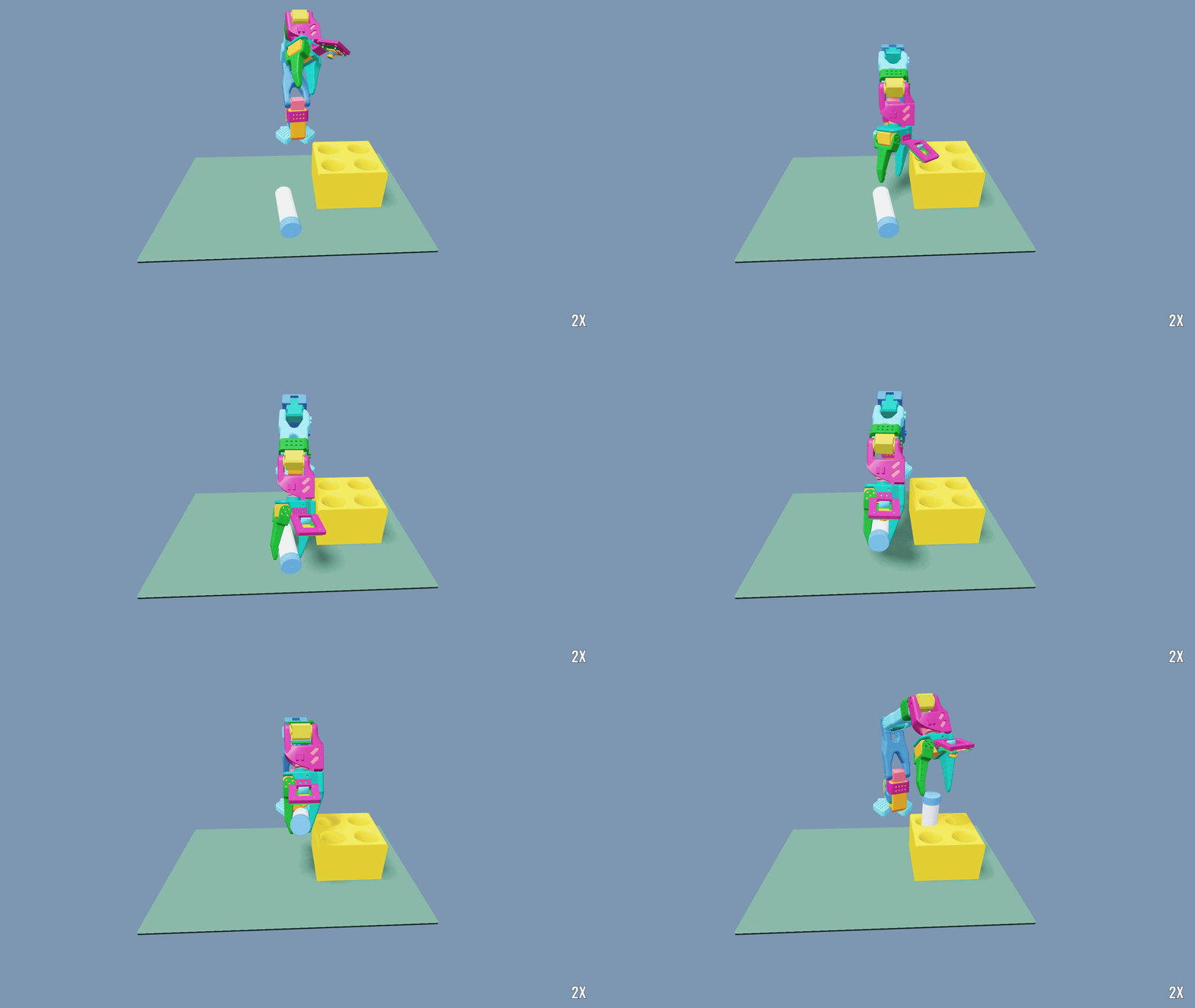
This tutorial builds a complete robot-learning workflow around an SO-101 arm that picks up a vial and places it in a rack. Instead of assembling disconnected examples, you will work with a production-shaped downstream project: IsaacLabTutorial main branch. The project includes the robot and workshop assets, a manager-based reinforcement-learning environment, state and wrist-camera observations, RSL-RL agent configurations, tests, state-policy training, and state-to-vision policy distillation.
By the end, you will know how a downstream Isaac Lab task is packaged, discovered, validated, trained, and evaluated. You will also know where to change the robot, scene, MDP, and learning configuration for your own task.
.. grid:: 1 2 3 3
   :gutter: 2

   .. grid-item-card:: **1. Set up**
      :link: tutorial-so101-setup
      :link-type: ref

      Install the project and verify task discovery.

   .. grid-item-card:: **2. Tour the project**
      :link: tutorial-so101-project
      :link-type: ref

      Find the assets, task terms, configurations, and tests.

   .. grid-item-card:: **3. Understand the task**
      :link: tutorial-so101-task
      :link-type: ref

      Connect the scene, actions, observations, resets, rewards, and physics.

   .. grid-item-card:: **4. Validate**
      :link: tutorial-so101-validate
      :link-type: ref

      Run tests, a zero-agent smoke test, and a benchmark.

   .. grid-item-card:: **5. Train and evaluate**
      :link: tutorial-so101-train
      :link-type: ref

      Train a state teacher, distill a wrist-camera policy, and measure success.

   .. grid-item-card:: **6. Make it yours**
      :link: tutorial-so101-extend
      :link-type: ref

      Adapt the task without tangling reusable and robot-specific code.
You need Python 3.12, uv, Git, and an NVIDIA GPU. The tutorial uses Newton with the MJWarp solver, so the primary workflow does not require the Isaac Sim application. Review the :ref:`system requirements <installation-system-requirements>` before starting.
Clone the tutorial's main branch and create its environment:
git clone https://github.com/isaac-sim/IsaacLabTutorial.git
cd IsaacLabTutorial
uv sync
The project pins Isaac Lab's develop branch through pyproject.toml, so it does not require a sibling Isaac Lab
checkout. uv sync creates the environment and installs the tutorial, Isaac Lab, and their runtime dependencies.
This repository is also a complete example of the downstream project produced by the :doc:`Isaac Lab template generator </source/developer-tools/template_generator>`. Use the generator when starting your own project, then follow the same package layout and task-discovery pattern shown here.
Confirm that the shared CLI discovers the downstream package:
uv run isaaclab --help
uv run python -c 'import importlib.metadata; print([e.name for e in importlib.metadata.entry_points(group="isaaclab.tasks")])'
The second command should include so101-vial-place. Task discovery works because the project publishes an
isaaclab.tasks entry point:
[project.entry-points."isaaclab.tasks"]
so101-vial-place = "isaaclab_tutorial.tasks"
Importing that package registers three Gymnasium task IDs:
| Task ID | Policy observations |
|---|---|
IsaacTutorial-Place-Vial-SO101 |
Robot, vial, rack, placement, and progress state |
IsaacTutorial-Place-Vial-SO101-Camera |
Direct-from-scratch PPO with 64 by 48 wrist RGB plus proprioception |
IsaacTutorial-Place-Vial-SO101-Camera-Distillation |
State-to-vision distillation with the same deployed camera observations |
Tip
Run all remaining commands from the IsaacLabTutorial directory. Train the state task first: it is the
baseline and supplies the teacher checkpoint used by the distillation task.
The project keeps reusable task logic separate from SO-101-specific configuration:
IsaacLabTutorial/
|-- pyproject.toml                     package metadata and task-discovery entry point
|-- media/                              reference rollout
|-- src/isaaclab_tutorial/
|   |-- assets/                        workshop and reset-pose data
|   |-- tasks/place_vial/
|   |   |-- mdp/                       actions, events, observations, rewards, and progress logic
|   |   |-- reset/                     reset dataset, curriculum, and generation logic
|   |   `-- config/so101/
|   |       |-- __init__.py            Gymnasium task registration
|   |       |-- env_cfg.py             scene, MDP, and physics configuration
|   |       |-- camera_env_cfg.py      wrist-camera task variant
|   |       `-- agents/                PPO and distillation configurations and models
|   `-- utils/                         exact rollout evaluation helpers
`-- tests/                              behavioral and configuration contracts
This boundary is intentional. A new robot gets a sibling of config/so101 and reuses the vial-placement
MDP. A different manipulation problem gets a sibling of tasks/place_vial and owns its task terms.
The registration connects a task ID to the generic manager-based environment, the task configuration, and its default RSL-RL agent:
gym.register(
    id="IsaacTutorial-Place-Vial-SO101",
    entry_point="isaaclab.envs:ManagerBasedRLEnv",
    disable_env_checker=True,
    kwargs={
        "env_cfg_entry_point": f"{_PACKAGE}.env_cfg:SO101VialEnvCfg",
        "rsl_rl_cfg_entry_point": f"{agents.__name__}.rsl_rl_ppo_cfg:SO101StatePPORunnerCfg",
        "default_agent": "rsl_rl",
    },
)
This is why the normal isaaclab train, play, and benchmark commands work without project-local
launcher scripts.
The environment is assembled declaratively with :class:`~isaaclab.envs.ManagerBasedRLEnvCfg`. The main configuration connects one scene configuration and one configuration for each MDP manager:
@configclass
class SO101VialEnvCfg(ManagerBasedRLEnvCfg):
    scene = SO101SceneCfg(num_envs=4096, env_spacing=0.9, replicate_physics=True)
    actions = ActionsCfg()
    observations = ObservationsCfg()
    events = DatasetEventsCfg()
    rewards = RewardsCfg()
    terminations = TerminationsCfg()

    def __post_init__(self):
        self.decimation = 4
        self.episode_length_s = 20.0
        self.is_finite_horizon = False
        self.sim.dt = 1.0 / 120.0
        self.sim.physics = PhysicsCfg()
The 120 Hz simulation and decimation of four give the policy a 30 Hz control rate. replicate_physics=True
allows the same scene to scale across thousands of environments.
SO101SceneCfg contains a fixed-base SO-101, a free 20 g vial, the rack, a collision mat, contact sensors on
both jaws and the vial, and a dome light. The robot configuration, identified actuator dynamics, and limits come
from Isaac Lab's SO101_CFG.
The six-dimensional policy action contains five bounded, relative arm-joint position increments and one bounded relative gripper increment. The task never attaches the vial to the gripper and never writes its pose after reset. Grasping, transport, insertion, and release must therefore succeed through simulated contact.
| Component | Contract |
|---|---|
| Actions | Five arm-joint increments, scaled to 0.033 rad per control step, and one jaw increment. |
| State actor | Joint state and targets, previous action, end-effector state, vial state, rack-relative target, placement features, and irreversible progress flags. |
| Camera actor | No object state: randomized 64 by 48 wrist RGB plus noisy joint state, targets, and previous action. |
| Critic | Privileged state observations plus physical contact state. |
| Events | Reset-pose sampling and modest vial mass and friction randomization. |
| Rewards | Compact object-to-goal shaping, physical milestone rewards, a success bonus, loss penalty, and small action-rate and joint-velocity costs. |
| Terminations | Successful placement, a lost vial, unstable robot state, or the 20 s time limit. |
Long-horizon manipulation is difficult to learn from the initial tabletop pose alone. The project therefore replays physics-validated reset poses across eight phases:
home -> pregrasp -> grasp -> lift -> reorient -> transport -> insert -> release
Training samples these phases as a reset curriculum. Each phase remains part of the same task: observations, actions, rewards, and termination criteria do not change. Progress flags advance only when physical evidence is present—for example, bilateral jaw contact near the intended grasp point and a measured load-bearing lift. Interactive play returns to phase-zero starts so the final policy must complete the entire task.
The active reward is intentionally small. Most shaping candidates remain configured with zero weight so experiments
can be reproduced without hiding behavior in ad hoc code. Read mdp/terms.py for the physical predicates and
reset/curriculum.py for the reset distribution.
SO101VialEnvCfg is the fully observed baseline. SO101VialCameraEnvCfg subclasses it, adds the wrist camera,
and replaces only the actor observations. Its asymmetric critic retains full state during direct PPO training.
SO101VialCameraDistillationEnvCfg additionally exposes the state teacher and a training-only geometry target;
the deployed student still consumes only wrist RGB and proprioception.
Start with fast checks. They catch broken assets, registration, geometry, rewards, reset data, and configuration contracts before a long GPU run:
uv run pytest -q
uv run ruff check .
Next, construct and step a small vectorized environment with zero actions:
uv run isaaclab zero_agent \
  --task IsaacTutorial-Place-Vial-SO101 \
  --num_envs 8 --visualizer none presets=newton_mjwarp
If this fails, fix task discovery, asset loading, or simulation stability before tuning RL. When it passes, measure the environment separately from the learning algorithm:
uv run isaaclab benchmark runtime \
  --task IsaacTutorial-Place-Vial-SO101 \
  --num_envs 4096 --num_steps 1000 --warmup_steps 50 \
  --visualizer none presets=newton_mjwarp
Reduce --num_envs if the batch does not fit your GPU. For the camera task, add the Newton renderer preset and
start with a smaller batch:
uv run isaaclab benchmark runtime \
  --task IsaacTutorial-Place-Vial-SO101-Camera \
  --num_envs 1024 --num_steps 1000 --warmup_steps 50 \
--visualizer none presets=newton_mjwarp,newton_rendererTrain the state teacher with RSL-RL. The task's default agent configuration is an 800-iteration run:
CUDA_VISIBLE_DEVICES=0 uv run isaaclab train --rl_library rsl_rl \
  --task IsaacTutorial-Place-Vial-SO101 \
  --num_envs 4096 --max_iterations 800 --seed 42 \
  --run_name so101_vial_seed42 --device cuda:0 \
  --visualizer none presets=newton_mjwarp
Checkpoints and TensorBoard events are written below logs/rsl_rl/so101_vial_state/<run>; the final checkpoint is
model_799.pt. While training runs, inspect the learning curves in another terminal:
uv run tensorboard --logdir logs/rsl_rl/so101_vial_stateLook for rising episode completion metrics, not reward alone. A larger return can come from shaping without a corresponding increase in successful releases.
Play the trained teacher from the canonical home phase:
uv run isaaclab play --rl_library rsl_rl \
  --task IsaacTutorial-Place-Vial-SO101 \
  --num_envs 1 --checkpoint /path/to/state_model.pt --deterministic \
  --visualizer newton presets=newton_mjwarp
The rollout should start from the canonical home phase, pick up the horizontal vial, turn it upright, move it over the target hole, insert it, and open the jaw so gravity seats it in the rack.
Pass the finished teacher to the dedicated distillation task. Add the renderer preset because the student observes wrist RGB:
CUDA_VISIBLE_DEVICES=0 uv run isaaclab train --rl_library rsl_rl \
  --task IsaacTutorial-Place-Vial-SO101-Camera-Distillation \
  --num_envs 1024 --max_iterations 800 --seed 42 \
  --checkpoint /path/to/state_teacher.pt \
  --run_name wrist_distillation_seed42 --device cuda:0 \
  --visualizer none presets=newton_mjwarp,newton_renderer
Distillation is single-GPU. Its bounded replay DAgger runner begins with teacher trajectories, gradually adds student
recovery states, and retains a 25 percent teacher-action floor. A training-only geometry head supplies a dense
localization target, and sparse stochastic weight averaging stabilizes the final checkpoint. Outputs are written below
logs/rsl_rl/so101_vial_camera_distillation/<run>.
Play the distilled student with the same task ID used for training:
uv run isaaclab play --rl_library rsl_rl \
  --task IsaacTutorial-Place-Vial-SO101-Camera-Distillation \
  --num_envs 1 --checkpoint /path/to/distilled_model.pt --deterministic \
--visualizer newton presets=newton_mjwarp,newton_rendererA visually convincing rollout is not an evaluation. Run the tracked phase-zero start set headlessly with the project's external callback:
uv run isaaclab play --rl_library rsl_rl \
  --task IsaacTutorial-Place-Vial-SO101 \
  --num_envs 1024 --checkpoint /path/to/state_model.pt --deterministic \
  --external_callback isaaclab_tutorial.utils.evaluation.install_episode_counter \
  --visualizer none presets=newton_mjwarp
Use the same 1,024-start contract for the distilled policy:
uv run isaaclab play --rl_library rsl_rl \
  --task IsaacTutorial-Place-Vial-SO101-Camera-Distillation \
  --num_envs 1024 --checkpoint /path/to/distilled_model.pt --deterministic \
  --external_callback isaaclab_tutorial.utils.evaluation.install_episode_counter \
  --visualizer none presets=newton_mjwarp,newton_renderer
The callback runs each tracked start once and prints one SO101_EVAL_RESULT JSON record. Preserve that record,
the checkpoint, seed, task ID, and resolved configuration when comparing experiments. For reference, the results
reported on the tutorial's main branch are 99.4 percent success for the state teacher and 67.6--72.9 percent
success across repeated distilled-policy audits, with no unsafe rack contacts.
The checked-in reset dataset is ready for training. Generate or inspect a separate candidate without overwriting it:
uv run generate-so101-resets \
  --output checkpoints/reset_poses.pt --device cuda:0 \
  --visualizer none presets=newton_mjwarp

uv run view-so101-resets \
  --dataset checkpoints/reset_poses.pt --device cuda:0 \
--visualizer newton presets=newton_mjwarpChange one boundary at a time and rerun the tests, zero-agent smoke test, and benchmark before training:
| Goal | Start here |
|---|---|
| Change the scene or SO-101 | config/so101/env_cfg.py and assets/ |
| Change actor inputs | Observation groups in env_cfg.py or camera_env_cfg.py |
| Change task behavior | Reusable functions and manager terms in mdp/ |
| Change reset coverage | reset/curriculum.py and the validated reset dataset |
| Change PPO or distillation | config/so101/agents/rsl_rl_ppo_cfg.py, rsl_rl_distillation_cfg.py, and distillation.py |
| Add another robot | Add config/<robot_name>/ and register new task IDs there; keep the shared MDP robot-agnostic. |
| Add another manipulation task | Add a sibling of tasks/place_vial with its own MDP and robot configurations. |
Keep these invariants as the task evolves:
- Task IDs resolve through the package entry point—do not copy Isaac Lab's launcher scripts.
- Policy action order and scale match the robot command contract.
- Physical quantities and quaternions use Isaac Lab's current conventions; Isaac Lab 3 uses XYZW quaternion order.
- Resets create valid physical states, and post-reset task code does not teleport the manipulated object.
- Success requires a released, mechanically seated vial rather than proximity to the rack.
- Tests cover observable task contracts, while a benchmark checks that changes did not move expensive work into the per-environment step loop.
From here, use :ref:`Task Design Workflows <feature-workflows>` for the manager/direct architecture, :ref:`Reinforcement Learning <rl-frameworks>` for framework details, and :doc:`Hydra Configuration System </source/features/hydra>` for command-line overrides.