

I build inspectable AI systems around models: dataset recovery, human review, evidence-oriented tools, reproducible experiments, and deployment workflows.


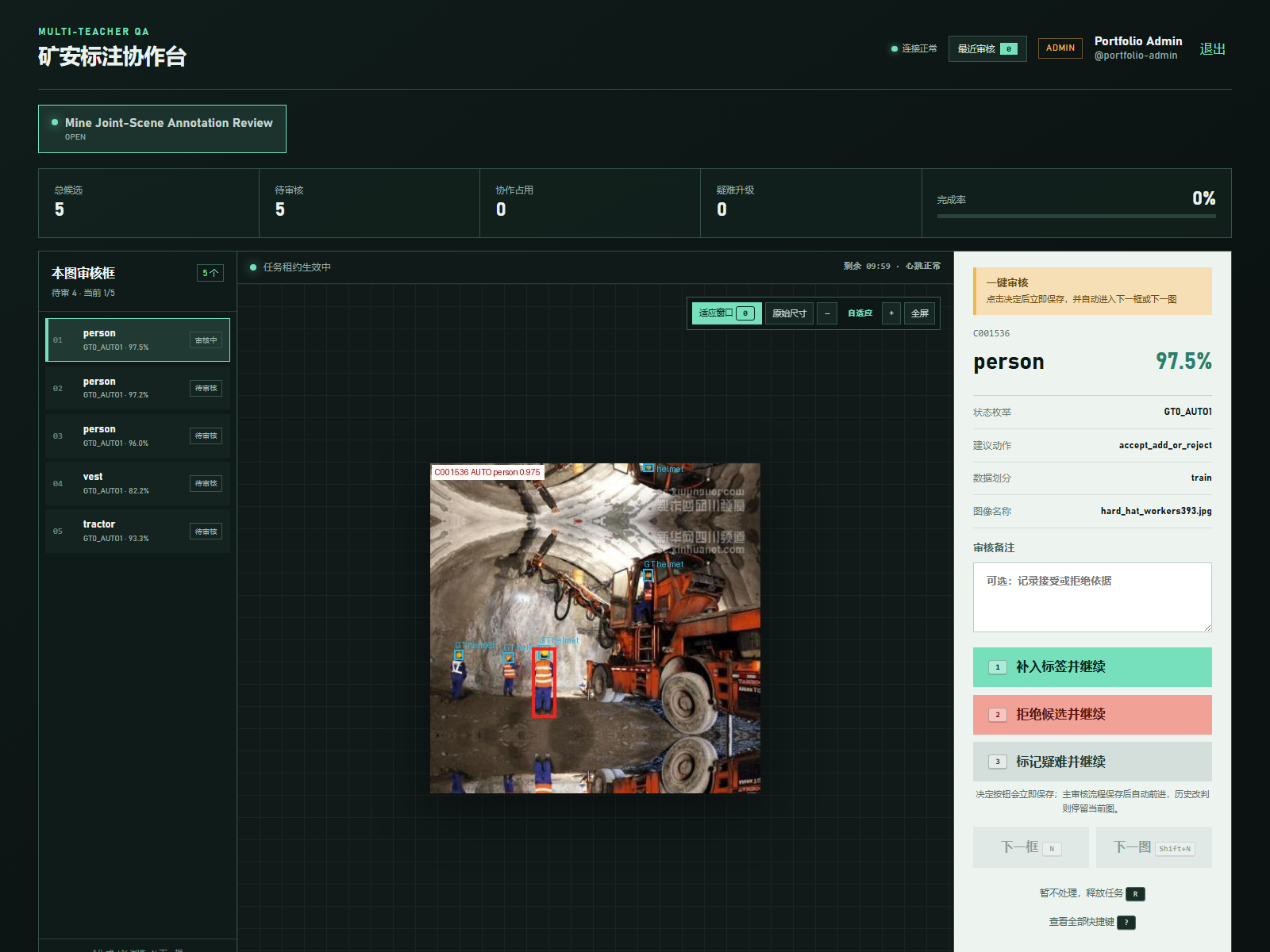
An end-to-end human-in-the-loop system for recovering missing YOLO labels with multiple single-class teacher models.
- Enumerates GT/AUTO relationships with IoU, IoS, center distance, area ratio, duplicate detection, and cross-class conflict evidence.
- Streams six teacher models sequentially to control GPU and host memory pressure.
- Provides a Vue 3 + Spring Boot + MySQL review platform with JWT/RBAC, project membership, image-level atomic claiming, renewable group leases, optimistic versions, and immutable audit events.
- Completed a real review round of 30,183 candidates and exports immutable decisions for dataset regeneration and 5090 retraining.
- Verified by Python tests, backend integration tests, frontend builds, operational runbooks, and real product screenshots.
Repository · Platform architecture · Completion case study
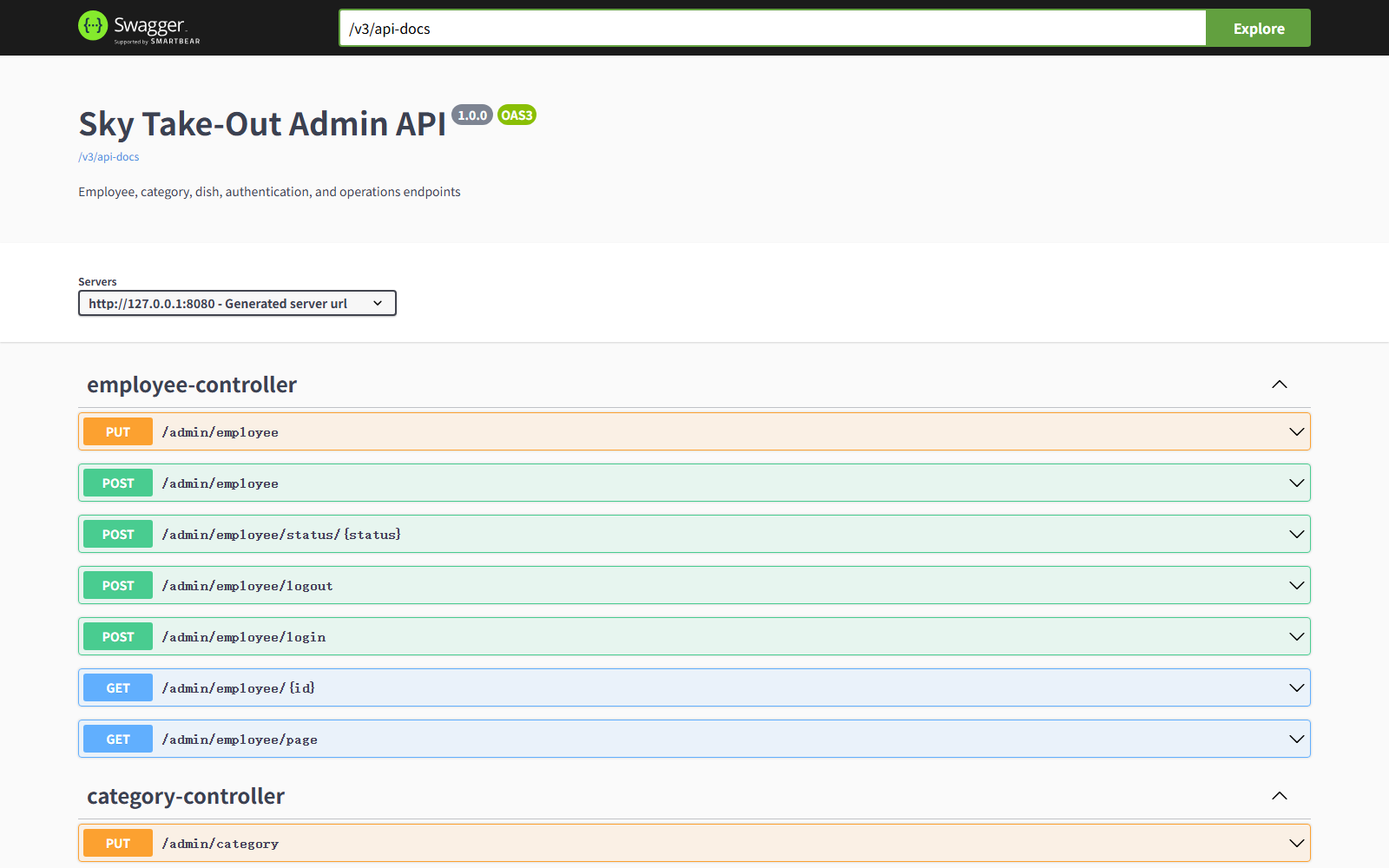
A Java 17 multi-module administration backend modernized from a learning project into an inspectable delivery case study.
- Replaced committed secrets with environment-driven configuration and documented the credential-rotation boundary.
- Added BCrypt with successful-login migration from legacy MD5, modern JJWT handling, request IDs, Actuator, Flyway, and OpenAPI.
- Added H2/MySQL-mode integration tests, Maven Wrapper, GitHub Actions, a non-root Docker image, and health-gated Compose services.
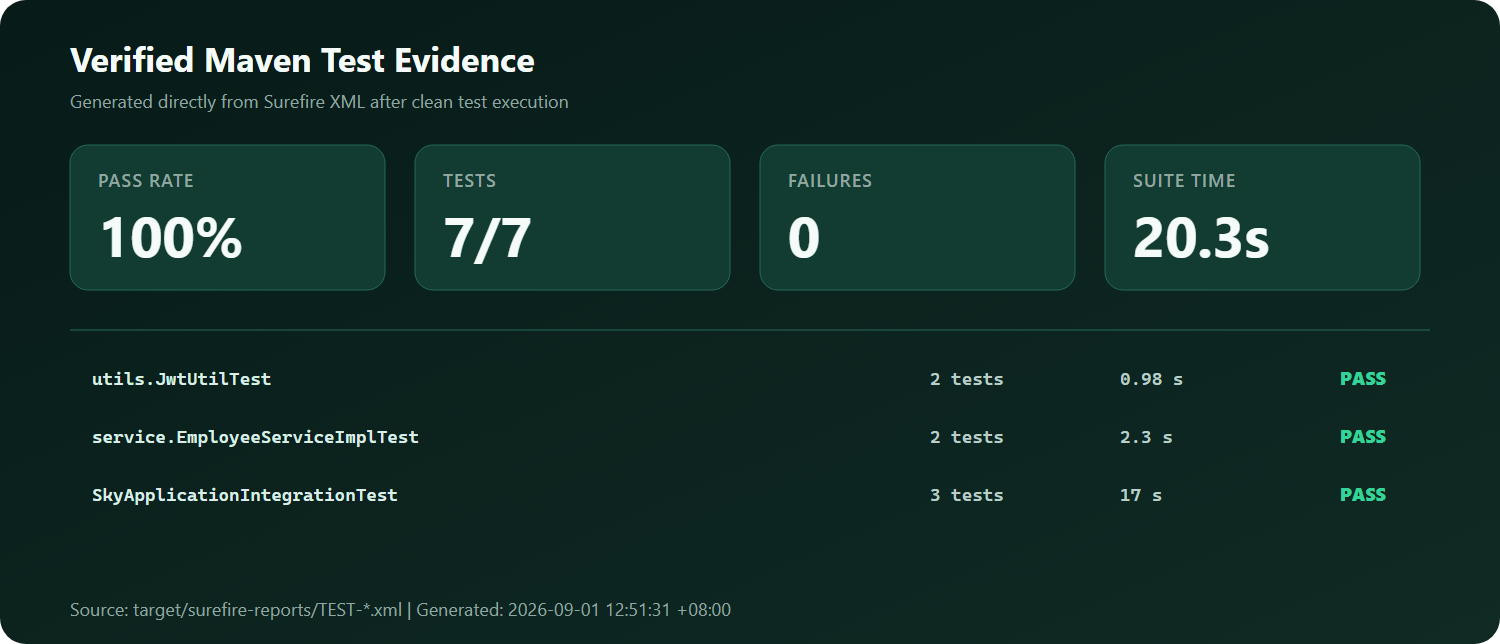
- Verified
7/7tests with0failures; the committed Swagger screenshot is captured from the running application. - Found and fixed a real converter-order bug that Base64-encoded
/v3/api-docs, then protected the endpoint with a regression test.
Repository · Architecture decisions · Security notes

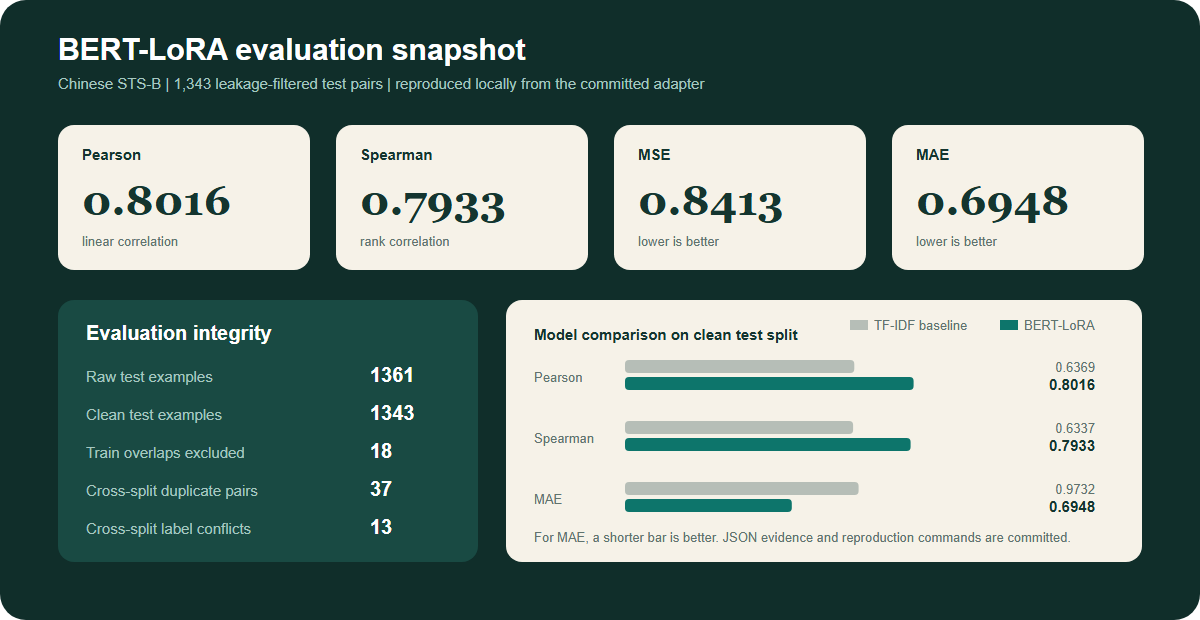
A reproducible Chinese semantic textual similarity service with both an explainable baseline and a BERT-LoRA backend.
- Audits symmetric pair leakage and label conflicts before evaluation, preserving a clean
1,343-pair test subset. - Provides a calibrated TF-IDF character n-gram baseline and a BERT + LoRA model behind the same FastAPI/CLI service contract.
- BERT-LoRA reaches Pearson
0.8016and Spearman0.7933on the clean split, versus0.6369and0.6337for the baseline. - Includes dynamic padding, gradient accumulation, CUDA-only FP16, clipping, early stopping, model/data cards, Docker, CI, and six passing tests.
- The UI screenshot is captured from a real API call and displays backend selection, score, interpretation, and latency.
Repository · Data card · Model card
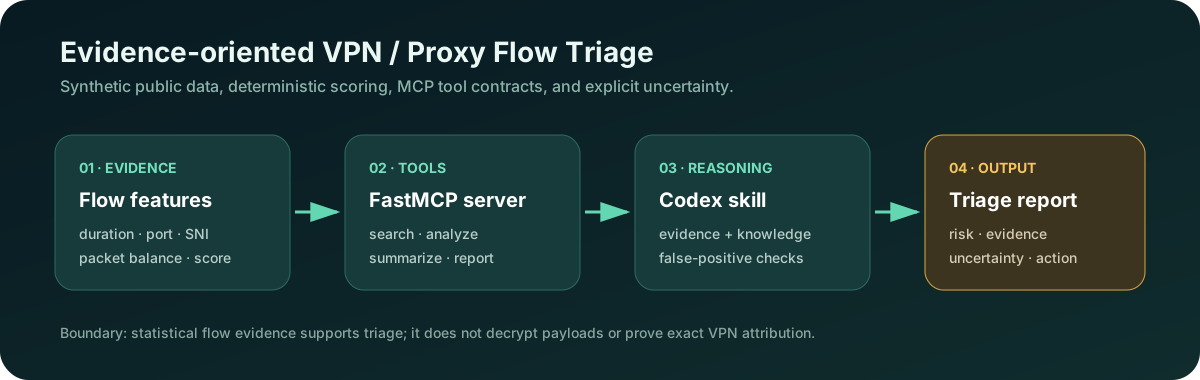
A sanitized FastMCP service and Codex skill that turn flow-level signals into bounded lookup, risk evidence, false-positive context, and triage reports.
- Keeps scoring deterministic while the agent handles explanation and workflow composition.
- Exposes five MCP tools plus a CLI from a standard installable Python package.
- Constrains language output to evidence, uncertainty, possible false positives, and next actions.
- Includes synthetic public data, English/Chinese skills, regression tests, and Python 3.10/3.12 CI.
Repository · Chinese design notes
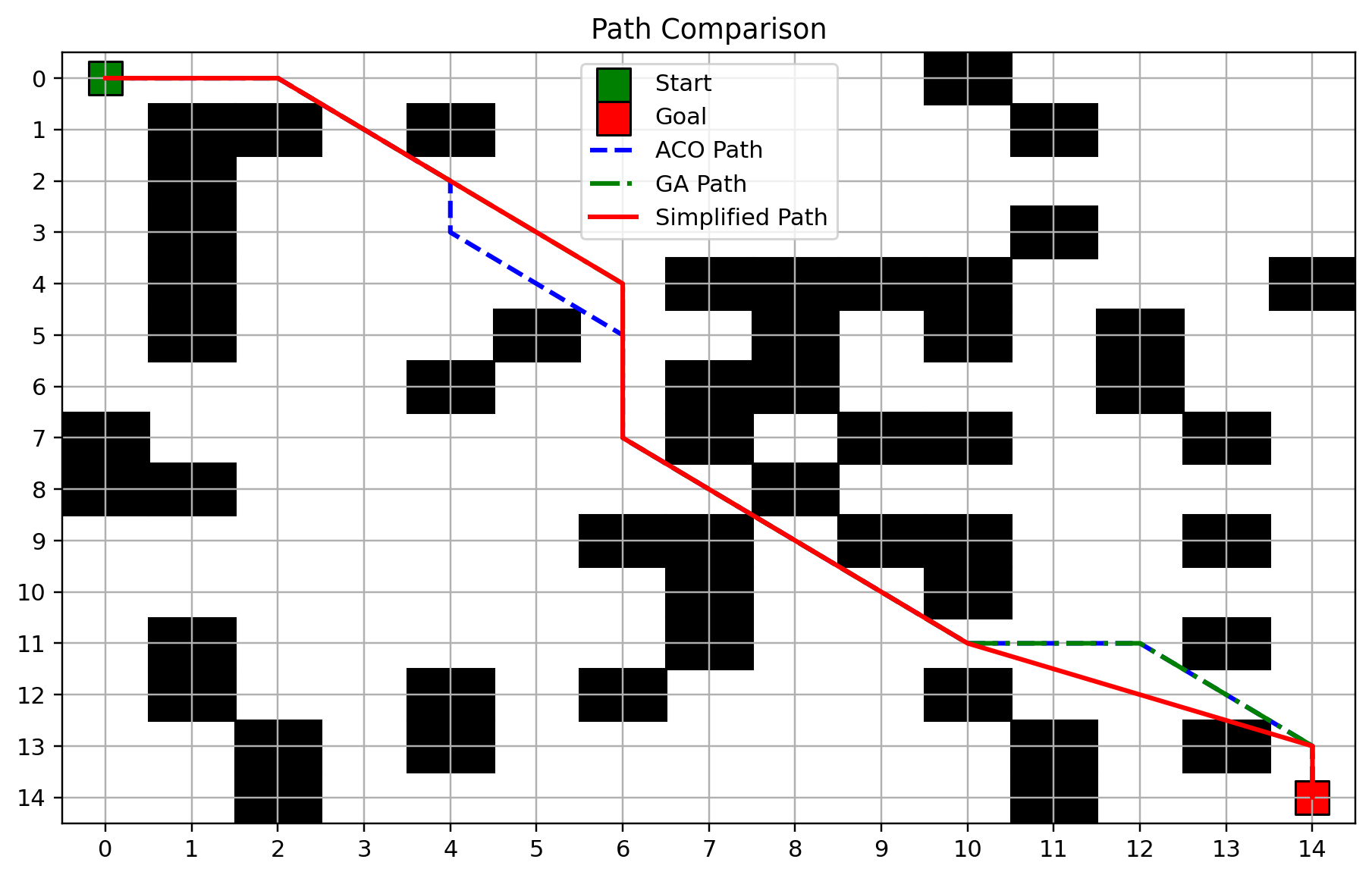
A seeded ACO-GA grid path-planning reproduction upgraded with validity checks and regression tests.
- Fixed a crossover bug that silently reduced population size every generation.
- Replaced unbounded recursive map regeneration with bounded BFS-validated generation.
- Added headless CLI execution, geometric length, turn count, collision checks, endpoint checks, and CI.
- On the committed seed-42 case, GA reduced turns from
8to6; simplification reduced19waypoints to7while remaining collision-free.
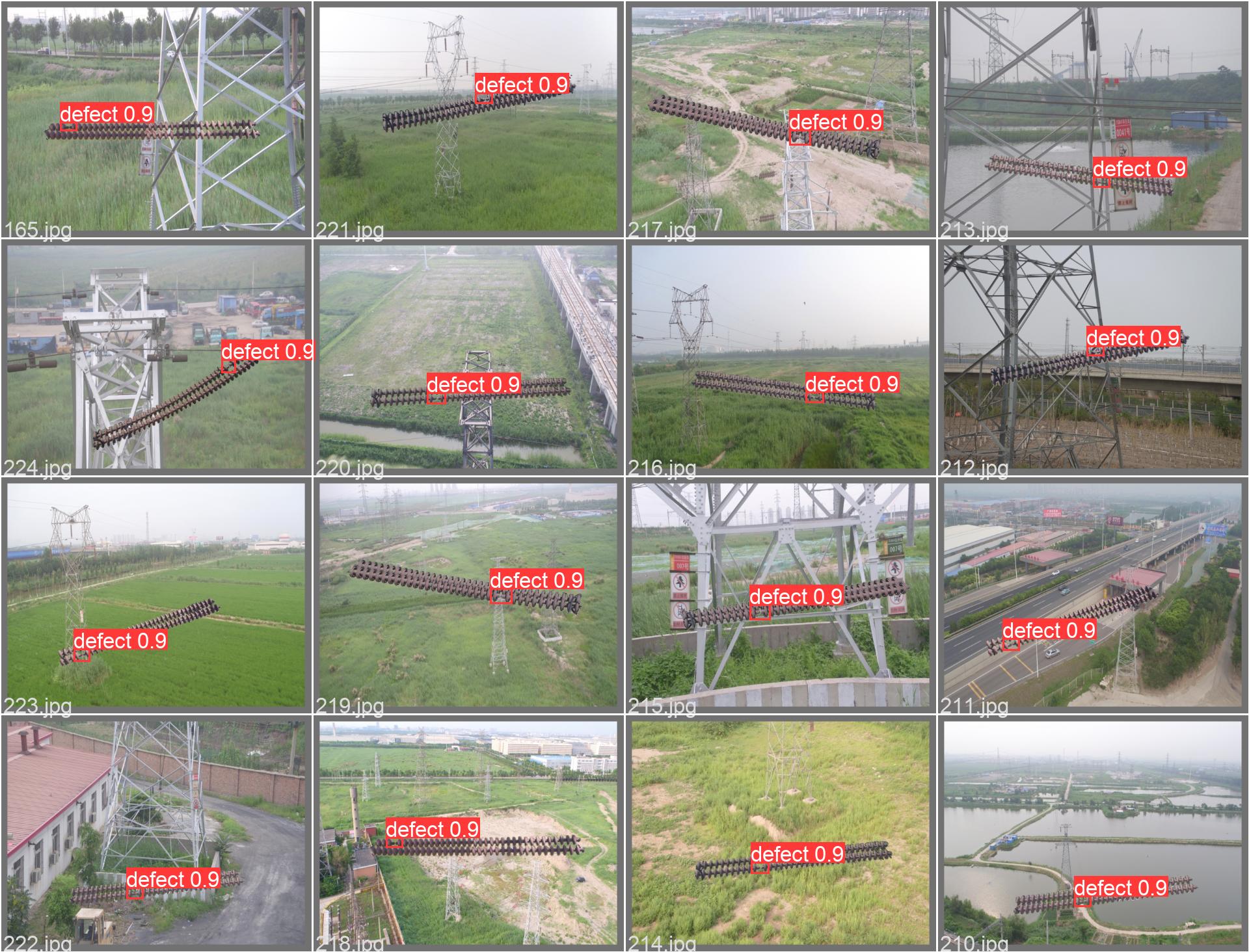
A preserved YOLOv5 single-class defect-detection experiment presented as an auditable case study rather than an overstated product.
- Retains real training curves, PR/F1 curves, confusion matrix, GT mosaics, and prediction mosaics.
- Separates project scripts from the external upstream YOLOv5 runtime and documents the compatibility boundary.
- Audits figure presence, dimensions, hashes, and runtime readiness in CI.
- Explicitly discusses why near-perfect validation plots do not prove field generalization without split manifests, leakage checks, negatives, and independent footage.
| Area | Evidence in these repositories |
|---|---|
| Computer vision | YOLO detection, small-object/overlap diagnosis, dataset QA, artifact interpretation |
| Data-centric AI | multi-teacher recovery, geometric matching, human review, frozen decisions, derived datasets |
| Backend engineering | Spring Boot REST API, MySQL/Flyway, JWT/RBAC, transactions, leases, optimistic locking, audit logs |
| Frontend engineering | Vue 3 + TypeScript collaborative review workflow, shortcuts, image navigation, lease/network status |
| NLP engineering | Chinese STS, BERT + LoRA, calibrated baselines, leakage-aware evaluation, FastAPI serving |
| Agent tooling | FastMCP tools, Codex skills, deterministic core/agentic edge, evidence constraints |
| Algorithm engineering | ACO/GA, seeded experiments, path metrics, regression tests, honest comparisons |
| Reproducibility | CLI entrypoints, CI, immutable artifacts, real screenshots, documented limits |
flowchart LR
    A[Define evidence and failure modes] --> B[Build the smallest reproducible core]
    B --> C[Test data, concurrency, and edge cases]
    C --> D[Add human review or agent tools]
    D --> E[Measure and preserve artifacts]
    E --> F[Document limits and deployment boundary]
I prefer projects that can answer five questions clearly:
- What real problem was observed?
- Which part is deterministic code and which part is model uncertainty?
- How are failures, stale writes, duplicates, or false positives handled?
- Which outputs can another engineer reproduce or audit?
- What is still missing before production use?
- yolo11-luna16-demo: chest nodule detection demo with GUI and SAHI.
- unet-camvid-segmentation: road-scene semantic segmentation experiment.
- project11-vit-finetune: Vision Transformer fine-tuning on CIFAR-10.
- GitHub: @jiapengLi11
- Email:
2284238579@qq.com
Public repositories intentionally exclude private datasets, production traffic, checkpoints, credentials, and internal deployment material. Claims are limited to the evidence retained in each repository.