


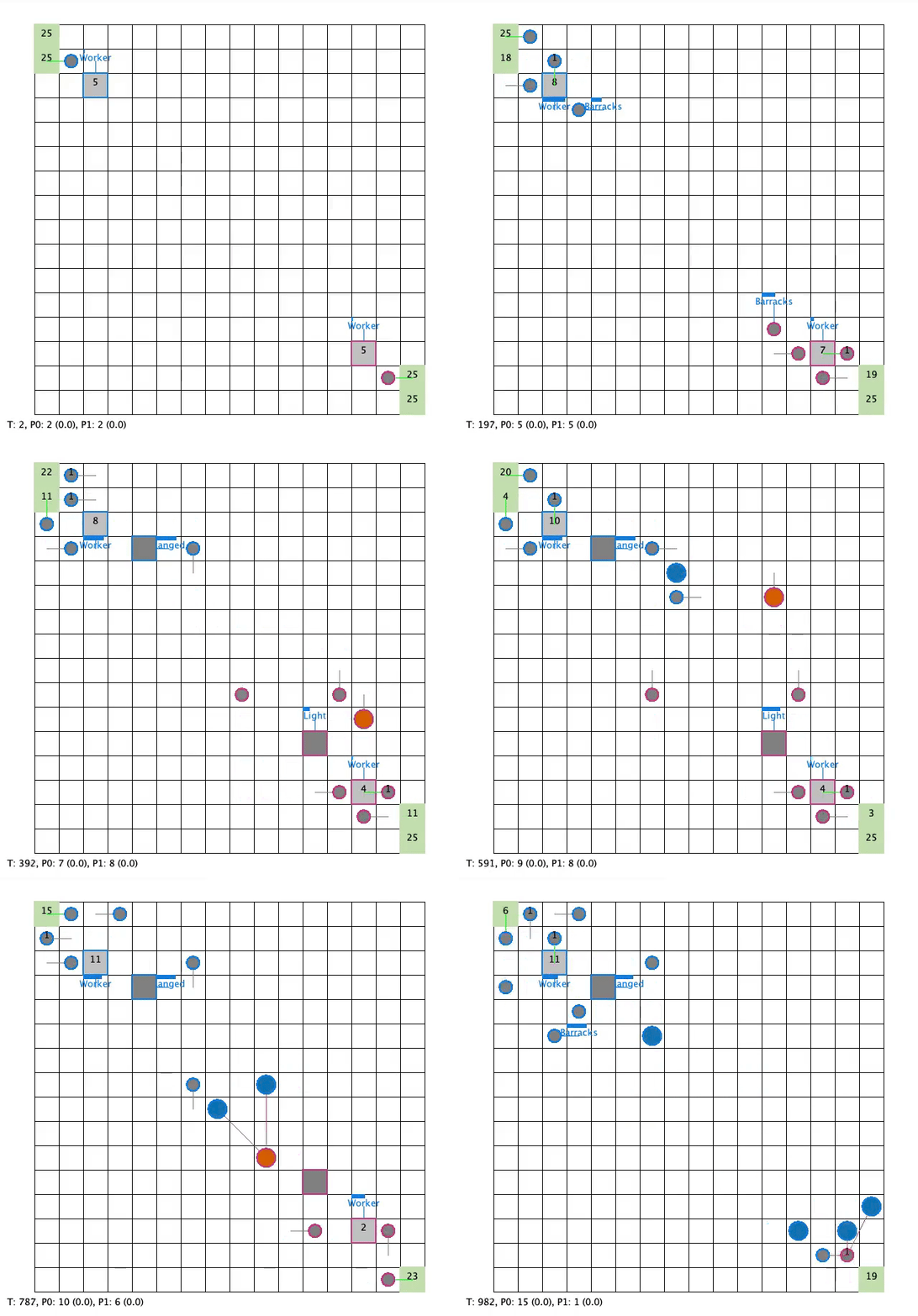
 |
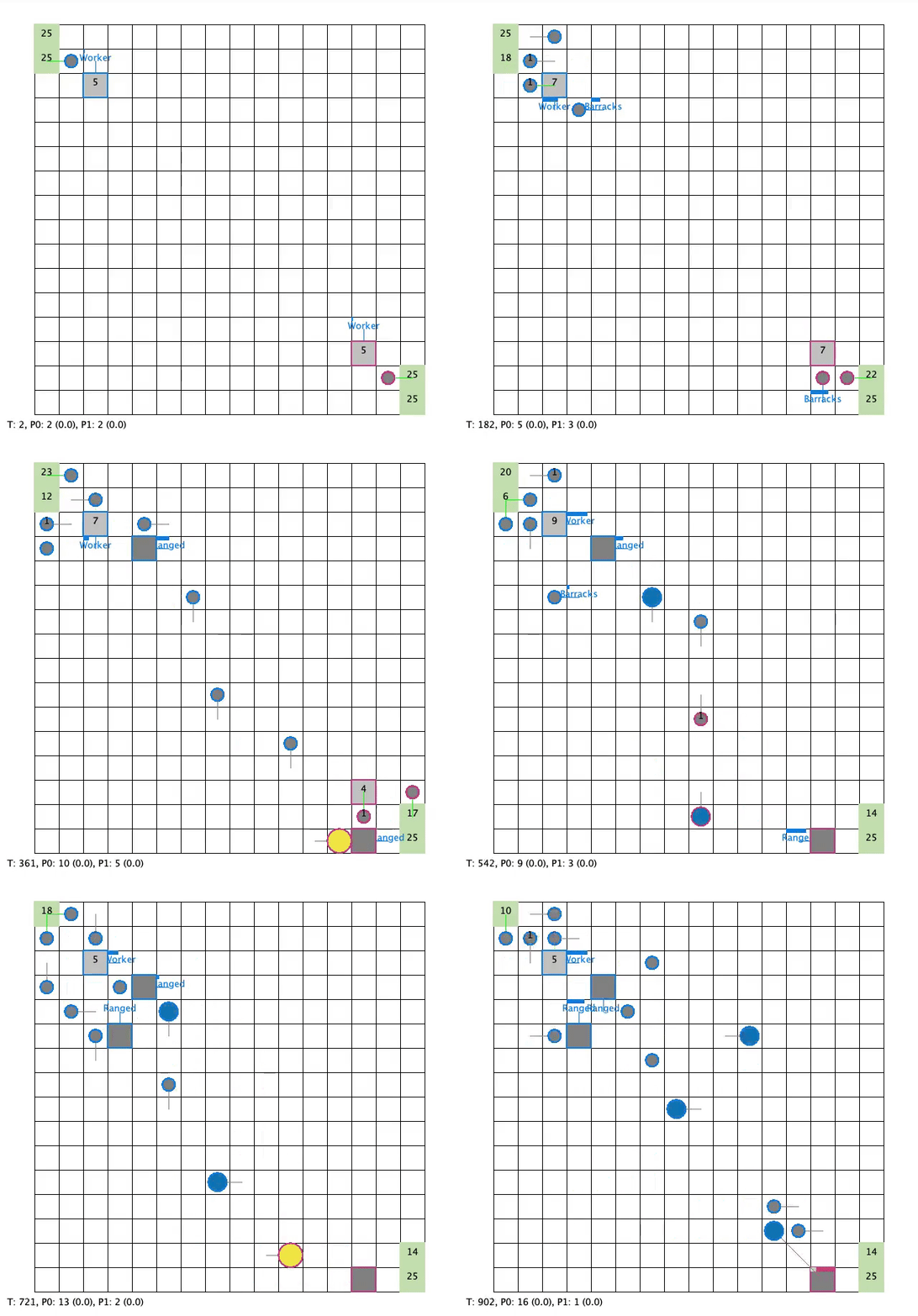 |
| UECD-Best vs RAISocketAI | UECD-Best vs CoacAI |
A DRL agent for MicroRTS fusing a U-Net spatial encoder with an entity-level Transformer (UECD). Trained on a 9.47-GPU-day academic budget, it tops a 19-agent IEEE-CoG-style tournament at 96.67% pool win rate and beats the reigning competition winner RAISocketAI in 65.7% of head-to-head games.
Fully released and installable from
pip install -e ..
Real-time strategy (RTS) games are among the most demanding benchmarks for sequential decision-making: players gather resources, coordinate many units, and plan over long horizons under real-time and combinatorial-action constraints. AlphaStar reached Grandmaster level in StarCraft II at the cost of hundreds of accelerators running for weeks, beyond academic reach; MicroRTS distills these difficulties onto small grid maps while keeping training tractable on a modest budget, and has been the subject of an annual competition since 2017.
This master's thesis investigates DRL for MicroRTS, guided by two questions: which architectural and algorithmic design decisions most improve a MicroRTS agent, and whether one competitive with the strongest prior competition entries can be trained within an academic compute budget. Starting from the Gym-microRTS GridNet baseline and taking RAISocketAI (the first DRL winner of the competition) as reference, every design decision is ablated individually before being combined.
Contributions:
- A reproducible CoG-style tournament framework over twelve maps and fifteen reference agents under five ranking metrics.
- An extended, modular Java/Python environment stack with composable wrappers and vectorized self-play.
- The UECD architecture fusing multi-scale convolution, entity-level Transformer reasoning, and bottleneck self-attention.
- A modular PPO pipeline whose mechanisms are ablated individually.
- A formal analysis of a discount-induced reward collapse under shaped-to-sparse annealing.
Results. The resulting agent, UECD-Best, combines these under a
two-phase opponent-curriculum fine-tuning schedule. On basesWorkers16x16A
it tops a 19-agent round-robin tournament (96.67% win rate, first on
four of five metrics) and wins 65.7% of its head-to-head games against
RAISocketAI, using 9.47 GPU-days and about 350M steps, below the
23.6 GPU-days and 500M steps RAISocketAI reports for its small-map
subset. A second agent, UECD-MultiMap, trained across five layouts of
three different sizes, spreads competence evenly with no per-map collapse,
showing that the padded environment and a prioritized-level-replay
curriculum make cross-layout training feasible.
The open-source pipeline released with this thesis offers a DRL substrate for future generalist agents and hybrid DRL/LLM systems.
- Dissertation (full text):
dissertation/dissertation.pdf(official version on UCLouvain DIAL) - Short paper (CoG 2026, accepted):
cog-2026-paper/cog_paper.pdf - Defense slides (20-minute oral defense deck):
defense/slides/main.pdf - Supplementary site (tournament visualisations, game recordings, analyses): https://mathisdelsart.github.io/microrts-drl-uecd-website/
Frozen at v0.1.0 and archived on Zenodo. The full pipeline (training,
evaluation, tournament, behaviour cloning, benchmarks, analysis) is
reproducible from one of two automated setup scripts under
setup/. Each script checks for a Java 17 JDK, rebuilds the
JNI bridge from source, installs the Python package with all extras
([dev,tournament]), and fetches the RAISocketAI competition wheel (the
cluster path also bootstraps a Python 3.6 sidecar for the UTS_Imass
bot). No proprietary dependencies.
# Laptop (macOS or Linux): creates the `microrts_agent` conda env
bash setup/local.sh
conda activate microrts_agent

# Or HPC cluster (CECI: Lyra, Manneback, ...): creates ./cluster_venv
bash setup/cluster.sh
source cluster_venv/bin/activate
Once activated, the unified CLI dispatches every operation:
microrts-agent --help
# train | evaluate | tournament | bc | bench | analysis
Seven numbered notebooks under examples/ walk through each
subcommand with shipped agents and tiny smoke budgets, so you can verify
the install and learn the CLI in ~30 minutes total.
| Folder | What's there | Doc |
|---|---|---|
microrts_agent/ |
The importable Python package: 80 modules across architectures/, training/, envs/, wrappers/, tournament/, registries/, bc/, bench/, analysis/, plus the vendored MicroRTS engine + JNI bridge |
README |
data/ |
Curated artefacts shipped with the repo: 9 trained agents, BC teacher dataset, headline tournaments (50 PDFs), 85 ablation runs, 36 game recordings, generalisation probes | README |
dissertation/ |
LaTeX source of the master's thesis, including 30 PDF figures regenerated by Python scripts in figs/figs-python/ from the shipped data/ tree |
README |
cog-2026-paper/ |
CoG 2026 accepted short paper (IEEEtran, single-file LaTeX) | README |
defense/ |
Beamer slide deck for the 20-minute oral defense (single-file metropolis source + compiled PDF + figure scripts) |
README |
experiments/ |
19 SLURM batch scripts: every shipped agent and ablation is reproducible from these drivers on a CECI HPC node | README |
examples/ |
7 numbered Jupyter notebooks, one per CLI subcommand, from 00_navigate (install + sanity check) to 06_analysis (metrics + audit + parameter counts) |
README |
tests/ |
pytest smoke suite: 124 tests covering imports, every CLI subcommand, every shipped agent, the JNI bridge, end-to-end train/evaluate, and dataset schemas (~90s in CI) | README |
setup/ |
Install scripts: local.sh (conda env on laptop), cluster.sh (venv on CECI HPC), _common.sh (shared helpers) |
README |
Every experiment ran on the HPC clusters of the CÉCI (Consortium des
Équipements de Calcul Intensif). See ACKNOWLEDGMENTS.md
for the full acknowledgment.
Released under the MIT License © 2026 Mathis Delsart.
If you use this code or any of the shipped artefacts in academic work,
please cite the project (CITATION.cff is the source of truth):
@software{delsart_microrts_drl_uecd_2026,
  author  = {Delsart, Mathis},
  title   = {{Deep Reinforcement Learning for Competitive Agents in MicroRTS: Architecture, Training, and Tournament Evaluation}},
  year    = {2026},
  version = {0.1.0},
  doi     = {10.5281/zenodo.20481385},
  url     = {https://github.com/mathisdelsart/microrts-drl-uecd/releases/tag/v0.1.0},
  note    = {Master's thesis, UCLouvain},
}Mathis Delsart, Master's thesis, UCLouvain.