A local dashboard for Markdown-first novel repositories. ✍️
Proseview reads a folder of Markdown scenes and reports lexical health, pacing, character presence, and revision history. The same pages can be read, edited, and annotated in place.
Core analysis stays on your machine: no account, subscription, database, or telemetry. AI features are opt-in and run through agent CLIs you installed and logged into yourself — Codex or Claude in the side dock. When you use one, Proseview sends the active document by default, plus any selection or attachments, to that agent under its own login and data handling.
Proseview reads plain .md files in whatever layout they already have, so it
sits alongside Obsidian, Vim, or any other Markdown editor.




The Analysis panel lists nine prose passes, each with the number of matches in this scene. Switching a row on marks the page you are reading: repetition, filter verbs, sensory language, passive voice.

Edit turns the page you were reading into the page you type into — same
typography, same highlights. Mod-S saves to the file, and the stats update.

Codex and Claude each get a tab and a separate project conversation. Opening another file does not replace either conversation or silently send that file to the agent. Attach the current file when you want it included.

Mod-K from anywhere. File paths, scene metadata, TODOs, notes, and prose,
grouped by kind.

Chapter proportion and words per scene, your storylines as lanes, and reading order against the order events actually happen — so a scene read far from where it happens is visible instead of inferred. Hover any scene for its card.

Clips use the bundled demo manuscript: Alice's Adventures in Wonderland (public domain), split into 39 scenes across 12 chapters with story fields filled in. See fixtures/demo-book.
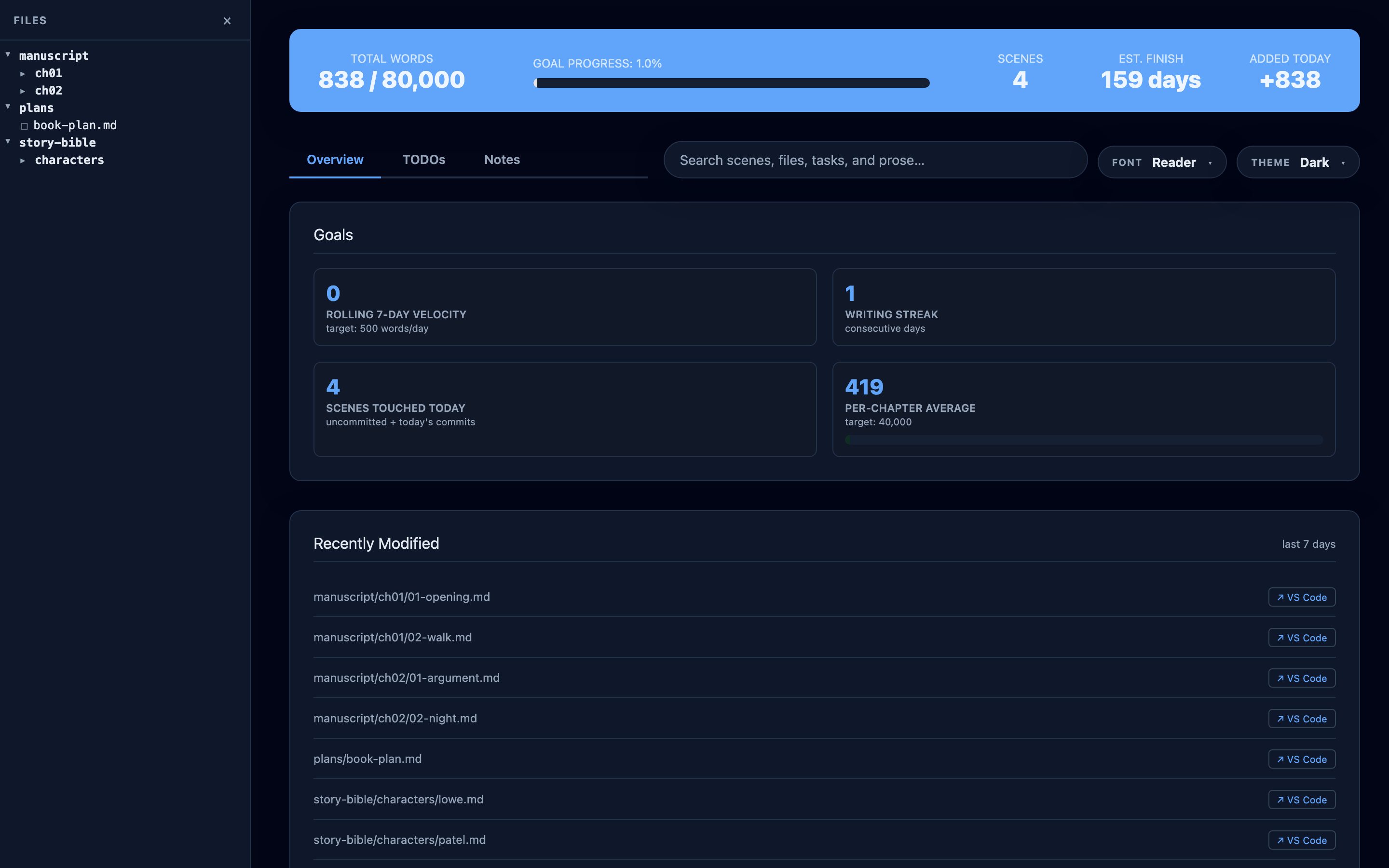
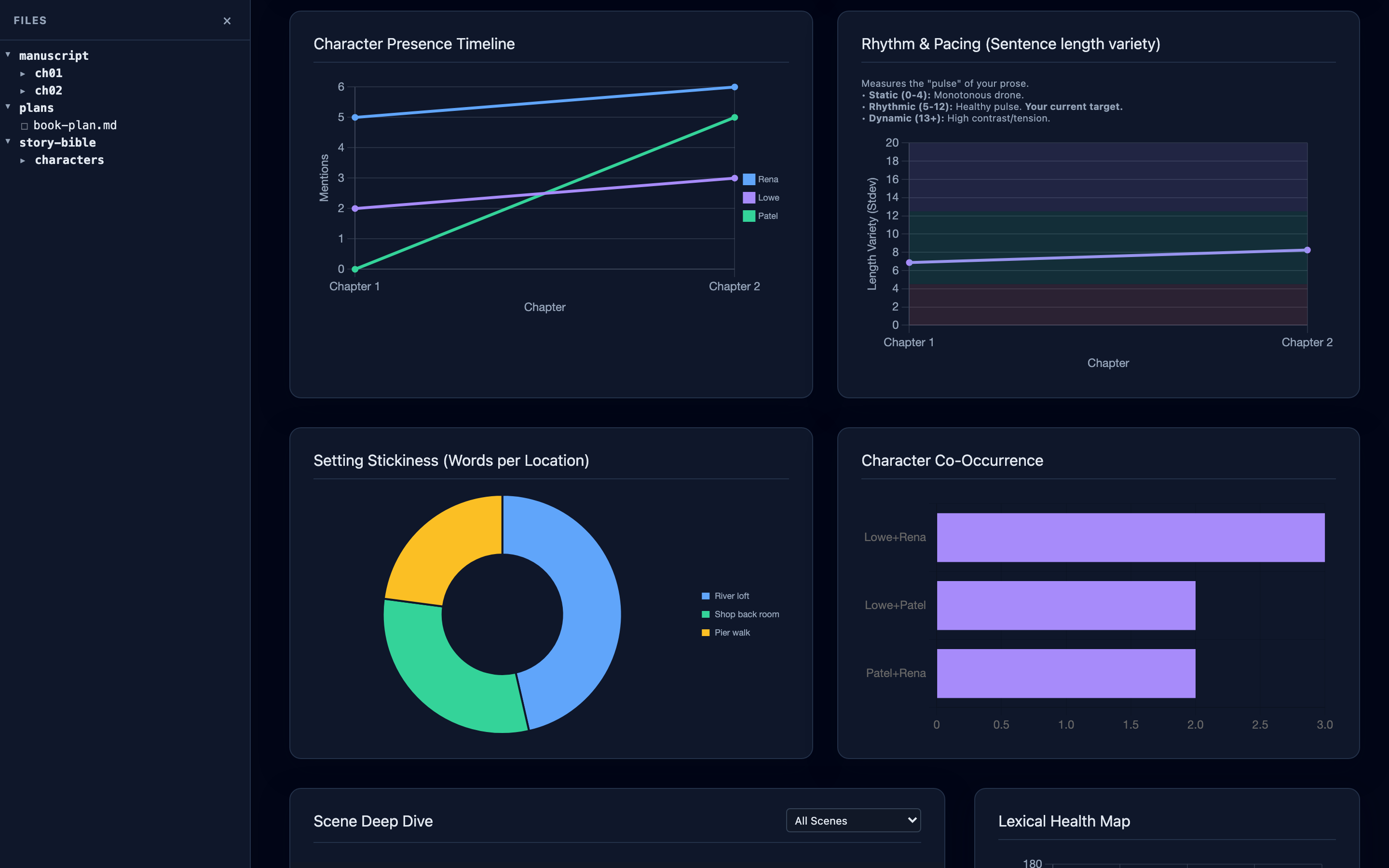
- 📊 Dashboard. Word count, chapter pacing, lexical health, sentence rhythm, character presence, setting stickiness, and a sortable scene table. What the numbers mean →
- 📖 Reading view and WYSIWYG editor. The same typographic page, with
Edittoggled on.Mod-Ssaves; a conflict guard checks the file mtime so a change made in your own editor is never silently overwritten. - 🎨 Editorial highlights. Nine prose passes over any scene, switched on from the Analysis panel with a match count each: repetition, passive voice, filter verbs, crutch words, hyperbole, lyrical reach, sensory density, comedy beats, first-person rate.
- 🗒️ Inline TODOs and Notes. Select a passage, drop a
TODOor a taggedNOTE, and it lands in the file as a Markdown comment. They stay in the file, so they survive in git and turn up in grep. - 🕰️ Timeline. The shape of the book, storylines as lanes, and reading order against the order events happen.
- 🤖 Two agents, side by side. Codex and Claude each get a dock tab and their own project conversation. Both run at once; switching tabs or opening another file never interrupts either one. How the AI features work →
- 🔎 Repository search.
Mod-Kfrom anywhere — paths, metadata, TODOs, notes, and prose, grouped by kind. - 📁 File browser. Create empty Markdown files and folders, rename them inline, or move them to Proseview Trash from the row menu or right-click.
- 🕹️ File history. Versions of a scene, restored through a diff you can read first.
- 📦 EPUB export.
proseview exportcompiles your scenes in the order the dashboard counts them. Export options → - 🔁 Live reload, deep links, themes. Save in your editor and the page follows. Every scene has a URL. Six themes, seven fonts.
- 🧪 Tested. A unit suite plus a browser tier that drives the real UI. One behaviour suite runs against both agents, so a feature cannot silently work on one tab and not the other.
Entirely optional, and it never runs on its own. Proseview has no model of its own and no API key of yours — it drives the agent CLIs already installed on your machine, under your login: Codex and Claude, one Discuss tab each.
Agent sessions are read-only. Anything beyond reading — a shell command, a file write — stops at an approval you have to grant, and raw model reasoning is never forwarded to the browser.
Continuity and canon questions come back with citations, and suggested edits arrive as proposals you accept or reject before anything is written.
Everything else works without an agent installed. Details →
Requirements: Python 3.11+ on macOS, Linux, or Windows.
pipx install proseview
proseview --root /path/to/your/novel
A browser tab opens at http://localhost:7842. Press Ctrl-C to stop.
Point it at any folder of Markdown. If there is no manuscript/ directory the
whole folder is the manuscript, so an Obsidian vault or a flat pile of chapter
files works with no configuration.
my-novel/
├── manuscript/
│   ├── ch01/
│   │   ├── 01-opening.md
│   │   └── 02-meeting.md
│   └── ch02/
│       └── 01-aftermath.md
└── .proseview.yaml          # optional
Frontmatter is optional. Proseview reads what is there and falls back on what is not. Layout and the full frontmatter contract →
Proseview runs without a config file. A .proseview.yaml at the repo root can
change where things live, set a word-count goal, pick which agent tab opens
first, or point the Timeline at your own frontmatter keys. proseview init
writes a starter file.
manuscript_path: manuscript/
target_words: 80000
discuss:
agent: codexProseview is alpha. Everything described above works today. Still unfinished:
- 🚧 Skills on the Claude tab. Codex discovers them today; Claude's picker is still empty.
- 🚧 Frontmatter editor (status, where, todos) inside the scene viewer so you don't need to drop into your text editor for routine fields.
See plans/roadmap.md for the full punch list.
pip install -e ".[dev]"
pytest
That runs 642 unit tests plus an HTTP end-to-end tier that boots a real
proseview subprocess and drives every endpoint — saves and the conflict
guard, TODOs and notes, the AI proposal bridge through the actual CLI, and
live reload over SSE — asserting on bytes written to disk.
Discuss integration tests use a deterministic fake app-server and isolated
home/state directories; they never contact Codex, the network, or your profile.
~15 seconds, no extra dependencies.
A browser tier drives the real UI in Chromium (editor round-trip fidelity, the selection menu, highlight passes, deep links, Discuss streaming/approvals/dock behavior, and applying an AI proposal end to end). It's opt-in:
pip install -e ".[e2e]"
python -m playwright install chromium
pytest -m e2e_browser
Both tiers work on a throwaway copy of fixtures/demo-repo. See
CONTRIBUTING.md for details.
MIT. See LICENSE.