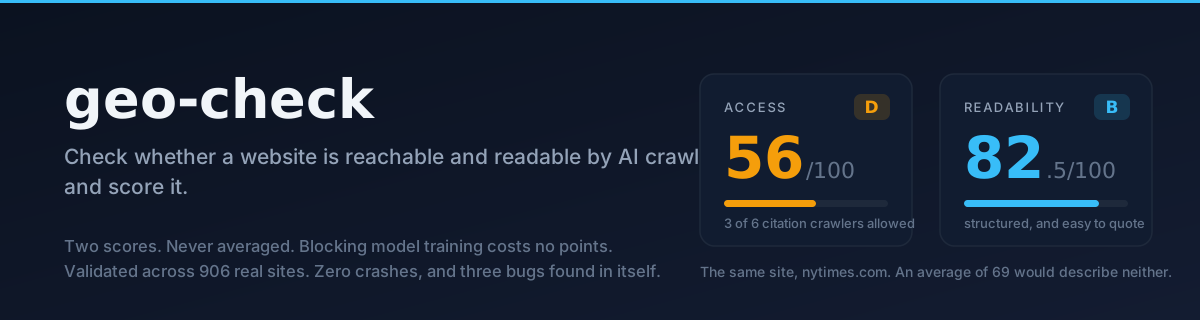


Check whether a website is reachable and readable by AI crawlers, and score it.
Two scores, never averaged. Blocking model training costs no points.
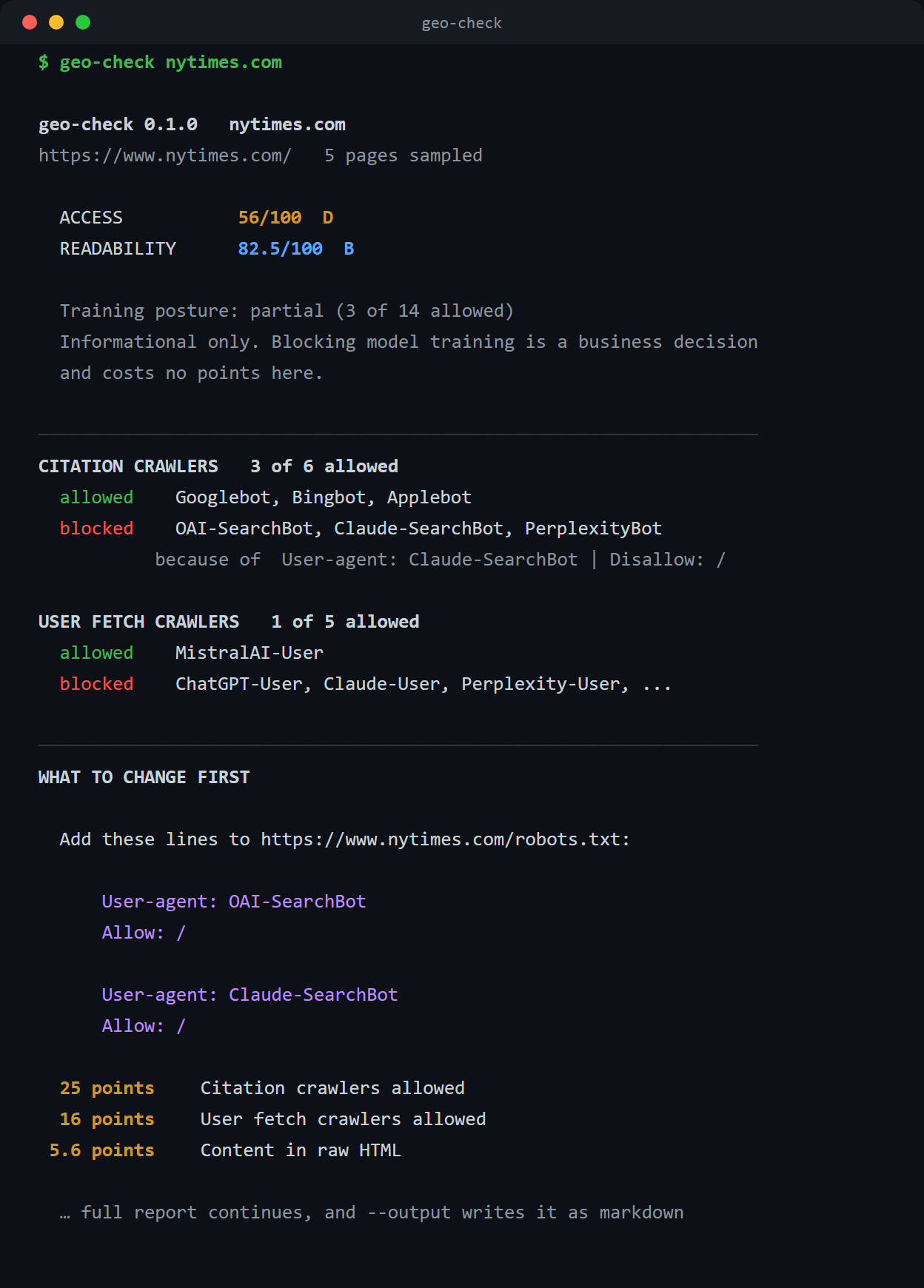
A real run, replayed from a recording committed to this repository. Trimmed for height.
git clone https://github.com/vasco-branco06/geo-check && cd geo-check
pip install -e .
geo-check your-domain.com
Python 3.10 or newer and open network access. No API key, no account, no model call. It does not run inside sandboxes that only reach an allowlist of domains.
Not on PyPI yet, so clone for now.
Or run it without installing anything: fork this repository, open the Actions tab, choose audit a site and press Run. The report lands in the run summary.
Generative Engine Optimization. The question is no longer only whether Google lists you, it is whether ChatGPT, Claude, Perplexity and AI Overviews can find you, read you, and quote you.
Most advice treats AI bots as one thing. They are not, and the confusion is expensive. OpenAI alone runs three crawlers that do different jobs:
| Crawler | What it does | Blocking it costs you |
|---|---|---|
GPTBot |
Collects pages for model training | Nothing in ChatGPT results |
OAI-SearchBot |
Decides whether ChatGPT can cite you | Your place in ChatGPT results, entirely |
ChatGPT-User |
Fetches a page someone asked about | Nothing, it is documented as ignoring robots.txt |
Those first two sit one line apart in a robots.txt file. Anthropic, Perplexity,
Google and Apple all split their crawlers the same way.
Some sites block the first on purpose and say so in public. Others opt out of training and remove themselves from ChatGPT at the same time without meaning to, and from outside a robots.txt file you cannot tell which is which. What you can tell is exactly which lines are there and what each one costs, which is what this prints.
Two scores, never averaged. excalidraw.com scores 100 on Access and 32 on
Readability. It is wide open to every crawler and unreadable by all of them. An
average of 66 would describe nothing true about that site and would hide the one
thing worth acting on, so the two never collapse into one figure.
Training crawlers are worth zero points, on purpose. Blocking model training is a legitimate business decision, not a mistake. A newspaper protecting its archive has done nothing wrong, and a tool that deducts points for it is not measuring, it is lobbying. Training appears as one informational line and never touches either score.
Nothing is scored by a model. No LLM sits in the scoring path. Every point
comes from a rule you can read in
docs/RUBRIC.md
and trace to the line of robots.txt or markup that earned it, so the same site
scores the same twice and a score you disagree with is an argument you can have.
Validated against 906 real sites, and the validation found bugs here first.
744 scored, zero crashes, and no abort without a reason. Every robots.txt was
then read three ways and compared per agent, 17025 verdicts, agreeing 100 percent
with an independent reader written from RFC 9309. Three implementations agreeing
proves consistency and not correctness, so the 289 verdicts that carry a score
were each traced by hand to the group that produced them.
It caught three real defects in this tool before anyone else could:
| Defect | What it would have done |
|---|---|
| User agents matched by substring | A site writing User-agent: bot would have silently blocked six citation crawlers at once |
| Groups declaring the same agent not merged | A site that contradicts itself got the first rule instead of the merge RFC 9309 requires |
A bare Crawl-delay closing nothing |
One site's CCBot inherited a Disallow aimed at a marketing crawler |
The 342 MB of recordings behind that are too large to ship, so
data/corpus_manifest.csv
carries the SHA-256 of every robots.txt as it was read, all 906 rows, dated.
python scripts/verify_manifest.py --sample 25 fetches them today and tells you
which still match. The evidence, and what it does not prove, is in
docs/VALIDATION.md.
A site is one deploy away from losing its AI visibility, and nobody notices for
months. Add this to any workflow and a bad robots.txt fails the build:
- uses: vasco-branco06/geo-check@v0
  with:
    domain: your-domain.com
    fail-under-access: 60
    fail-under-readability: 50
Both thresholds are optional. Leave them out and it reports without failing. The full report goes into the job summary, and the scores come back as outputs you can read in later steps.
It is on the GitHub Marketplace.
Access is whether AI systems can reach the site at all. Citation crawlers allowed (50), user fetch crawlers allowed (20), sampled pages reachable without a login wall (15), sitemap declared and reachable (10), no noindex (5).
Readability is whether an AI system can make sense of a page once it has it. Content in the raw HTML without JavaScript (30), valid JSON-LD (20), heading structure (15), title and meta description (10), author and dates (10), canonical (5), llms.txt (5), answer shaped content (5).
Grades: 90 and above A, 75 to 89 B, 60 to 74 C, 40 to 59 D, below 40 F.
Three critical failures cap the Access score. All citation crawlers blocked caps
it at 20. A blanket Disallow: / caps it at 10. A homepage that does not return
200 aborts the run, because there is nothing honest to score.
The full rubric, with the reasoning and the weaknesses it still has, is in docs/RUBRIC.md.
Isn't this just reading robots.txt?
That is one of the thirteen checks, and it is the one most tools get wrong.
Matching a crawler to a group is a specification, not a substring search, and
following RFC 9309 properly is where all three bugs found here lived. The other
twelve read the sitemap, llms.txt, and five sampled pages for structure,
JSON-LD, headings, authorship and whether the content survives without
JavaScript.
Why doesn't blocking model training cost points? Because it is a decision, not a defect. Plenty of publishers block training deliberately and are right to. A tool that deducts for it has an opinion about your business model rather than a measurement of your site. It is reported as one line so you can see it, and it moves neither score.
Why two scores instead of one?
Because they fail independently and different people fix them. A site can be
perfectly reachable and impossible to read, or beautifully structured and blocked
at the first line of robots.txt. One number hides whichever half is broken.
Does it work if I am behind Cloudflare?
It reads what your robots.txt and markup say. It cannot see a bot manager
returning 403 to crawlers while serving you fine, and it says so in the report
rather than scoring around it. If the homepage refuses this tool, the run aborts
with the reason instead of inventing a score.
Why trust a number a heuristic produced?
Only trust the ones that are measured, and the report tells you which is which.
The JavaScript check is a heuristic with thresholds taken from 22 live pages, and
docs/RUBRIC.md
names the page in that sample it gets wrong. The robots.txt verdicts are not a
heuristic, and they carry most of the Access score.
Do I need llms.txt? Probably not urgently. It is a proposal rather than a standard and no major assistant is documented as requiring it, which is why it is worth 5 points out of 100 here and not more.
It does not detect blocking at the CDN or WAF level. Your robots.txt can say yes while Cloudflare returns 403 to AI crawlers, and this tool will not see it.
It does not render JavaScript. The raw HTML check measures how much readable text arrives in the initial response and how much of that response is script. The thresholds were measured across 22 live pages rather than chosen, and both the numbers and the script that produced them are in the repository.
Answer shaped content is detected structurally. The check can see that a page has an ordered list of five steps and that the prose is broken into sections. It cannot see whether either is any good.
It does not measure whether AI assistants actually cite you. That is a different and much larger problem.
Twenty five user agents, each with its vendor, its bucket, whether the vendor
documents it as honouring robots.txt, and a link to that documentation.
docs/CRAWLERS.md
explains how the buckets work and why three of the on demand fetchers are
reported as ignoring a block aimed at them.
The list moves. Pull requests adding or correcting an entry, with the vendor's own documentation URL, are the most useful contribution you can make.
Adding a check is one file in src/geo_check/checks/ and one line in the
registry.
pip install -e ".[dev]" && pytest164 tests, offline, about fifteen seconds. The suite never touches the network. CONTRIBUTING.md has the rest: how a check is written, how the golden set works, how to record fixtures, and why the recorder is deliberately slow. SECURITY.md carries one known and unfixed issue worth reading before you pipe this tool's output into an agent.
MIT.